|
March 30, 2017 Have the economics changed on tariffs?
Tariffs on imported goods have been in the news lately. Traditional economics says that tariffs are bad because less-expensive imported goods are good for consumers. Goods cost less so people can buy more. It is a simple equation, but I wonder if automation is changing the calculus? Just about all experts in automation agree that increasing unemployment of humans is inevitable and soon (if not already) there won’t be enough jobs for everyone that wants one. I believe global trade and automation have already made jobs across the world a zero-sum game. That is, a job gained in one country necessarily means a job lost in another country. In the United States, there is some basic level of support given to people regardless of whether they are employed. We can argue about the quality of the support, but no one can say that
it is free. The people that are employed must pay for the support. If we take it as a given that jobs have become a zero-sum game, then every imported manufactured good has necessarily caused job loss in this country. Since jobs lost in this way will cost this country money because we must support the unemployed, why doesn’t it make sense to tax the imported items at the border? That way the people considering buying the imported items will
see more of the true cost of the item. If we don’t make the cost of imported items reflect their true cost, aren’t we in fact subsidizing imported manufactured goods through our welfare system? I would love to hear reader’s thoughts on this.
September 17, 2016 Some geeky robotics stuff
I got an email the other day from an undergraduate student asking
about a control interface for a micro-manipulator. They are
currently using an "RC style" joystick with the twist
controlling z-axis motion and up-down/back-forth controlling x and
y. It springs back to neutral when no force is applied. Here is how
I answered.
Dear Student: I would call what you are working on a Human Machine Interface (HMI). I bet there's a visual component (computer screen, VR goggles, etc.) along with the hand controller part.
The hand controller part is also often called the manual
controller.
Frankly, if you only need to control X, Y and Z it's going to be tough to beat a traditional joystick like you already have. My experience is that humans are most precise using the small muscles of their hands and fingers, and that's the scale of a traditional joystick. Some force feedback might be helpful. You could experiment with
that, but I don't recommend a manual controller that is at the scale of whole arm or body
motion to control a micro manipulator.
If you are going to try to design a force feedback manual controller, it needs to be very high bandwidth. The structure needs to be very light, there needs to be no backlash and the actuators need to be backdrivable. The Phantom haptic device http://www.dentsable.com/haptic-phantom-omni.htm is a good example of a design that follows these principles and is at the scale of small movements of the hands and fingers.
You could look at this design and learn from it.
May 5, 2016 Things don't seem to be changing very fast.
I got an email the other day asking if I would contribute to an online story about how different things would be in 2020 "if Moore's law continues to hold true." When I replied that 2020 was only 3.5 years away and Moore doesn't believe his law is holding true anymore, there was no
real response. I didn't participate in this story, but it might be fun to read if it does get written.
Who doesn't like a science fantasy story?
Moore's law specifically speaks to the density of transistors on an integrated circuit, but often is applied to all things
computer. This includes desktop and notebook computers, of course, but also tablets, smart phones, servers, wired and wireless networks, etc. Regardless of whether Moore's law holds true, this technology in 2020 is not going to be much different than it is now in 2016. To me, it is not changing very fast any more. Let's take a look at how it changed between 2012 and 2016. The iPhone 6s is out now, but the iPhone 7 should come out later this year. The iPhone 5 came out in 2012. Sure the iPhone 7 will be better than the iPhone 5, but going from an iPhone 5 to an iPhone 7 isn't going to change anyone's life. The iPhone 9 will likely come out in 2020. Sure it will be better than my iPhone 6s. I hope I can keep my 6s running until 2020. Then I'll get an iPhone 9, but making the move is not going to change my life. Not one bit. I can make the same case with notebook computers, tablet computers and just about every other computing-type technology I can think of. 5G wireless should be rolled-out by 2020. That will be nice, but not that different. The extra bandwidth will just get filled up with ads or other digital debris. Sure, self-driving cars are going to be huge and a great benefit, but that's not going to happen in 2020. I hope to see it in my life time. That might be another 35 years - 2051. As great as they will be, self-driving cars are really just a part of the computer revolution. The computer revolution is very much a
continuation of the semiconductor revolution and all experts I am aware of agree that the semiconductor revolution is very long in the tooth.
To me the fundamental questions are, what will replace
semiconductor technology and when will that happen? Until something
replaces the semiconductors in computing devices, I believe we will
continue to see incremental advances in computing applications, but
they will come more slowly than they have since the middle of
last century when the first transistors were demonstrated. It is
much more fun to pretend otherwise, but I just don't see it.
September 20, 2015 Where are all the robots?
A good friend of mine sent me this link to an article about robotics and wrote, "I’m sure this article is common knowledge to you...” Sadly, this is common knowledge to me because it reminds me of how little progress has been made in the robot part of robotics
over the thirty years since I started in the field as a grad
student. Certainly, the automation and machinery part of robotics has made great strides, but as I’ve written before, there’s
more to a robot than automation and machinery. This article is about one of the best robots in the world and, to quote from the article, “The contraption weighs 407 pounds and is powerful enough to bench-press 150 pounds. It’s hazardous for humans to be around.” That strength to weight ratio is terrible and the contraption is hazardous for humans to be around? That is pretty much exactly where we were thirty years ago. This article starts by listing some of the tasks from the 2015 Darpa Robotics Challenge finals. This competition showcased the best robots in the world. Each of these robots has been under development for at least three years with many millions of dollars in funding per robot. The tasks the robots faced in the challenge were really quite modest. They included walking up a flight of stairs, turning a knob, flipping a switch, and the like. Conceptually these tasks are much simpler than the tasks a fruit fly faces every day. Most of the robots couldn’t complete the tasks, but two of them did. Take a look at the video on
YouTube. The robots don’t look much like humans. They certainly don’t show any type of higher-level thinking. As I’ve
written before and unlike a lot of people, I don’t believe robots based on digital computers will ever approach human intelligence. The article above also talks about how much money is currently being invested in robotics by
big players that have a lot of money to invest - Google and Uber being two discussed in the article. I have no doubt that this influx of money will generate even more amazing automation and machinery, but I also have no doubt that
these robots will never approach human intelligence.
July 29, 2014 Robots just keep
coming for our jobs
I've written many times that raising the minimum wage is just
going to accelerate the deployment of robotics and automation to
eliminate these jobs. I think the jobs in the fast food industry are
especially vulnerable. Because I work in robotics and automation I
often think of the social implications of this. What will happen
when the jobs flipping hamburgers are all gone? How will that
teenager learn a work ethic and find a stepping stone to something
better? To jobs flipping hamburgers, I say good riddance. That
teenager would do a lot better spending their time studying their
schoolwork. The same goes for jobs packing boxes, kitting parts,
unloading machines, picking parts off a conveyor belt, etc. Just
preserving busy work for minimum wage is a loser's game and raising
the minimum wage is just going to end the game more quickly.
But how about jobs like taking care of elderly people? Here's an
article in the NY Times that talks about what people in robotics
have been talking about for a long time - that social robots in the
home are
going to be caregivers
for the elderly. I was being interviewed on a radio show several
years ago on this very subject and all I could express is "why
would we want to deploy robots for this?" I had one of the
worst headaches I've ever had after that interview. I can't think of
anything worse for robots to do. There's an emotional aspect to this
kind of work that robots will never be able to fill and robotics
researchers who suggest otherwise are just plain wrong. Another engineer on the show
represented the opinion that there was a shortage of people to do
this kind of work. That's why we needed to deploy robots. The truth
to this statement is that there is a shortage of people willing to
do this kind of work for the money we are currently willing to pay
for it.
Of course there is some amount of pay where Americans would be
willing to do this kind of work. The
elderly, however, are often on very tight budgets and don't have the
money to pay for it. People on the left side of the
political spectrum, have written about this issue and suggested that
the answer is government subsidized home care for the elderly. I
very rarely support government subsidies. This includes
corporate welfare and tax breaks for the wealthy. I don't think
subsidies help anyone. At the lower end of the income spectrum,
they disincentivize working, At the higher end of the income spectrum, they just contribute
to income inequality. Over the last ten years the government has
dumped more borrowed money into the economy than in the combined
history of the United States and income inequality has gotten vastly
worse.
As for subsidized home care for the elderly, I
guess in this case we don't have to worry about disincentivizing the
elderly. It's not like they would run out and get jobs if it wasn't
for the subsidized caregivers. We already are subsidizing health care
and this is very much a health care issue. On the
conservative side of the political coin is the position that this is the
responsibility of family, church and charitable organizations. This
was a reasonable approach when people didn't live so long, and I
think it is still a reasonable approach for other social issues, but
now care giving for the elderly is just too much for this social network to
handle.
Though the use of robots as caregivers for the elderly is an
interesting social and political topic, it is also a hypothetical
one. As I've written many times before,
robots based on digital computers are never going to remotely
approach human intelligence and human intelligence is required to
replace people in caring for the elderly, whether in their homes or in group homes. Sure
there will be devices like glorified smart phones and mechanical
assist devices that will help,
but there won't be robots with human-like intelligence.
July 17, 2014 Super job
opportunity for a Lead Robotics Engineer
General: Infratek is a new technological start-up and university spin-off company focused on providing
innova
innovative, full-spectrum infrastructure management systems. We innovate, integrate, and manufacture autonomous robots, cutting-edge non-destructive evaluation technologies, and software systems that assess and maintain critical infrastructure, to include bridges, roadways, and structures. Having recently been awarded funding, we are hiring engineers to be part of our first commercial launch, bringing research prototypes into industrialized products. As the Lead Robotics Engineer, you will be a key leader of the team.
Duties and Responsibilities:
·Overall responsible for the functional design and technical development of autonomous mobile robotic systems, providing expertise and leadership to the mechanical, electrical, software, and robotics engineers
·Provide system-level guidance on the overall functionality and development of robotic systems, ensuring that validation of customer requirements and verification of system performance parameters
·Lead and facilitate initial planning, concept development, and milestone design reviews
·Assist with hiring of candidates and staff by vetting select resumes and applications and conducting interviews
·Effectively utilize professional or academic networks
Required Skills and Experience:
·Doctorate or Master degree in Computer Science, Computer Engineering, Electrical Engineering, Mechanical Engineering or related discipline
·At least 5 years of experience in the design and development of autonomous systems, robotics systems, and human-robot interfaces
·Industry or research work with the full life cycle of robot development, from concept generation to design and manufacture
·Significant experience related to systems architecture, design, and system integration
·Familiarity with mechanical and electrical design of robotic systems
·Familiarity with core artificial intelligence concepts to include navigation, path planning, sensor fusion, and GUIs
Preferred Skills and Experience:
·Direct experience with autonomous, mobile, “rover-type” robotics
·Direct experience with the full product development lifecycle of robots, from design to delivery
·Experience or familiarity with non-destructive evaluation technology or the integration of robotic systems with infrastructure inspection sensor
Contact Colin O'Neill 856-532-2866 with inquiries.
June 7, 2014 Will robots take
over the world?
Over the years I’ve answered hundreds of email questions from young and old alike. Today I got one that asked if robots fart and another that asked if I thought robots would take over the world. As you might guess, these came from the younger side of the age spectrum. I answer their questions below, but first I have to define what the word “robot” means to me. It’s a bit different than the common definition.
The word Robot comes from a play called “Rossum’s Universal Robots” by the Czech playwright Karel
Capek. It premiered in 1921 and became very popular in its day. The play explored what has become a familiar theme in science fiction: humans playing God by creating synthetic humans (robots) in their own image. These robots could be enslaved without guilt because they possessed no souls. Eventually Capek’s robots grew resentful of their enslavement, rose up against humans and destroyed the human race. Though Capek adapted the word robot from the Czech word “robota” meaning forced labor (such as a serf would be forced to perform on the King’s land), the idea of robots is much older.
The notion of human-like creatures created by humans can be traced back to the word Golem that appears in the Old Testament. I’m not going to pretend to understand ancient Hebrew, so I can’t interpret what that word means in the context of the Old Testament, but over the last thousand years the legend of the Golem
evolved. The basic story is that a Rabbi or similar holy person can form a human-like shape out of clay. After speaking or writing the appropriate incantations, the Golem would become animated and serve the Rabbi, typically by performing dangerous tasks or protecting the village against attack. Of course sometimes the Golem would get out of control and turn on its makers. Sound familiar? Frankenstein anyone? Terminator?
These days the word robot is applied to just about any remote controlled or automatic system that does some sort of physical task. The word robot is even applied to non-physical software constructs that roam around on the internet (think search engine robots). I personally thank Joe Engelberger for starting this. In the 1950’s Joe founded
Unimation, Inc. which billed itself as the world’s first industrial robotics company. They sold their first “robot” to General Motors in the early 1960’s. This was an automated piece of manufacturing equipment that unloaded hot dies in the factory. To me, that’s no robot. That’s an automated piece of manufacturing equipment, but the name sounded sexy and Unimation was fairly successful.
Finally, we get to my definition of a robot so we can begin answering the questions that started this essay. To me a robot has to be of the same size and shape as a human. That’s what Capek intended when he coined the word. Capek’s robots were so similar to humans that they could be mistaken for humans. In my opinion, if it’s not human-like, it’s not a robot. Interestingly, Capek’s robots were not mechanical creatures, but rather were biological beings that were created in a lab and ran on chemical reactions. Capek doesn’t discuss the robots eating or what they might have eaten, but I assume being biological creations they must have eaten some sort of food. Since they were biological, ate food and ran on chemical reactions; Capek’s robots likely would have suffered from the same residual gaseous emissions that mammals do.
That answers one of these kid's question.
Now we get to the question of whether robots will take over the world. For starters, I don’t believe any robots in the true sense of Capek have been created, yet. Furthermore, I don’t think the robotic machines being designed today will take over the world any time soon. And by soon, I mean not in this century and not in the next. Here’s why I believe that to be true.
People who do say we’ll have robotic machines with brains as powerful as humans generally base their argument on Moore’s law. Moore’s law says that the number of transistors on a computer processor doubles every two years. I have two issues with this line of reasoning. First, there is no guarantee that Moore’s law will continue to hold. It’s not a real law, like the law of gravity. It’s just based on an observation Intel’s co-founder, Gordon Moore, made a long time ago. Second, the interconnections in human brains are much more complex than binary computer connections. The connections in human brains have variable levels, are electro-chemical and involve firing rates. This makes them more like analog signals than digital signals. If we assume the resolution of a connection in a human brain is 10 bits and use a common estimate of 100 trillion connections in a human brain, then we would need a digital computer with ten to the power of ninety transistors! Even if Moore’s law did hold true, it predicts the Sun will burn out before we have a digital computer with the power of a human brain. Basically there is no path from digital computers to the complexity of the human brain.
I don’t know if they will take over the world, but we are probably a lot closer to robots of the kind envisioned by Capek than most people think. I’m talking about cloning. Humans have cloned sheep, cats, dogs, pigs, deer, horses and bulls. It’s only a matter of time before we are able to clone humans. How about the little clone that will be created to provide an organ to replace a child’s damaged liver so the child can live? Is that little clone human? Is it a robot? What if a scientist can clone a person, but render the clone somehow inferior? Maybe it can’t talk, or maybe it can’t comprehend fear or pain? Will that clone have a soul? Will it have any kind of rights or protections? Would it be OK to create an army of clones to fight our wars for us? I don’t know the answer to these questions, but I’m sure we are going to be dealing with them, and likely in my children’s lifetime.
May 17, 2014 Raising
minimum wage will promote robotics
I was browsing around the internet and came upon this article with the title, "Scientists Worry Machines May
Outsmart Man." I realize it's old (from 2009), but the topic still comes up all the time. As I've written before, digital computers are never going to outsmart humans. What about Watson winning
Jeopardy you say? Watson is just a huge computer search engine with speech recognition built in. It's true that Jeopardy questions are often nuanced and contain subtle hints, but when the computer has encyclopedic knowledge, the nuance and subtleties don’t matter. The computer just looks up the answers. As I read the article, I also noticed that the headline was in conflict with the body of the article. Here is what is in the article, "The researchers — leading computer scientists, artificial intelligence researchers and roboticists who met at the Asilomar Conference Grounds on Monterey Bay in California — generally discounted the possibility of highly centralized
superintelligences." Here's another line from the article, "The researchers also discussed possible threats to human jobs, like self-driving cars, software-based personal assistants and service robots in the home."
Hello? Do we really need scientists to tell us that automation is going to take human jobs? Seen a lot of bank tellers lately? How about those folks that take your ticket when you leave the parking garage? I'm pretty sure most of those jobs have been lost to automation. How about switch board operators?
Do you even know what those are? At one time there were 350,000 people getting paid to do that job. Now there are none. This is my concern with raising the minimum wage. The higher the minimum wage goes, the faster these
low-level jobs will be lost to automation. I'm all for people earning a wage they can live on, but the Federal
government stepping in and artificially raising the minimum is, as usual, going to have the opposite of the intended effect. It will just accelerate the loss of these minimum wage jobs to automation. There will be one-tenth the number of people working at a McDonalds.
It will be just a few folks to service the machines in the kitchen and one person in front helping
the people who can't figure out how to use the touch screen to order their food.
May 5, 2014 Students explore human-robot interactions
I just read a column about and undergraduate course at Cornell on human-robot interactions. I didn’t
know there were undergraduate courses specifically addressing human-robot interactions, but I’m not surprised. The author writes that the field is so new that there aren’t even textbooks on it yet. I don’t know if that is true or not, but the field is certainly not new. It’s been around since the 1970’s and has focused primarily on safety of personnel working in the same locations as robots. As more and more automation is applied in the consumer market this study will move towards “lay people” that encounter robotics and automation in their daily lives. I’m sure safety will still be an important part of that study, but how to make the interaction “natural” for humans will also be a big part of it.
That leads me to a question I get by email all of the time, “what subjects should I study if I want to work with robots when I grow up?” The obvious answer would be to study math and science, but that’s rarely the answer I give. I think that students should study what they love and are best at. Then they can look for career fields where they can apply themselves. For example, the lead protagonist in Asimov’s “I, Robot” series is Susan Calvin, a robot psychologist. If psychology is your thing and you want to work in robotics, study psychology and figure out how to apply it to robotics and automation. When I was growing up I loved to take things apart, see how they worked, and then try to rebuild them so
they would be better than they were before. That naturally led me to study engineering and I’ve been very happy with that choice, but engineering is not for everyone and it shouldn't be forced on anyone. That's not the way to be happy and successful in life.
April 30, 2014
This is an interesting page that shows 10 different tasks people are doing with robots beyond the typical factory applications. As I've written many times before, calling these machines robots is really a stretch of the word as most of these are programmable machines rather than robots, but the applications are fun to learn about. I'm not sure what to call the system in the last piece where a woman is controlling the articulated arm using brain waves. Is it something like an early prototype of a
cyborg?
Q: Dear Dr. Hooper: I have been very interested in robotics which attach too humans and seem to work breath takingly well. I am interested in this field as a possible career path, I am currently doing my final year of schooling before university and I am curious to what subjects are most suitable to give me the skills to perhaps get me into
robotics?
A. The obvious answer to your question is to take engineering courses. Take a broad
spectrum of courses and see what you like best.
There may be other careers in the robotics field that are more focused on the interaction between robotics and humans. The lead protagonist in Asimov's I Robot series is a woman named Susan Calvin. She is a robot psychologist.
Q: Dr Hooper: Dan built an amazing robot for the the Northern Kentucky Has Talent Contest in the Science and Technology category.
Please take a look and vote on facebook.
A. I support the students and parents in Northern
Kentucky. I know from experience how hard Daniel worked on his
project and wish him the best of luck. Here's a link to the
youtube video of his latest creation.
I remember a flight I took on a small plane to visit a company in
Kentucky called Robotics Research Corporation in the 1980s. They
were making state-of-the-art robotic manipulators. There were
a bunch of us at the time making really cool robots. I've made
three humanoids since and have brought them into society as
responsible adults. I'm very proud of the robots and the humanoids.
Here's a snap of me from the late eighties.
November 2, 2013 Important Question
Q: Dr Hooper: I'm leaving the Air Force after 7
sevens years and am considering going to college in engineering
using the GI Bill. Here are my questions: should I go to college in
engineering, what should I study, and where should I go to school?
A. Thanks for note. I definitely recommend going to
college. As for what course of study, I recommend a broad science
and engineering curriculum your first year and then decide what
discipline to pursue. As for job prospects, the software engineers have the easiest time finding jobs, then computer/electrical and then mechanical. You can get a good engineering education at a lot of schools. Apply to the schools that you think best, but don't go somewhere that is going to get you into debt. With your GI Bill you should be able to get out of school with an engineering degree debt-free.
October 5, 2013 Important
Question
Q: Hello Rich: I didn't make it through college, I have a low paying job, I have a family, I can't just quit the paycheck and go back to school. I'm trying to decide what to do.
I would love to get into bionics.
A. First of all, great job working and
supporting you family, If I were you, I would teach myself to write software and go find a job as a computer programmer. Look at the software job postings in your area and see which languages are the most sought after. For some reason the popularity of different languages varies by geographic location. You could also just go with C# and Microsoft .net. It seems like those guys are always in demand these days. The key is that you really have to become an expert. Read some books, program some projects of your
own; and be able to answer questions like, "what makes object oriented languages object oriented?"
I always ask that question when I am interviewing job candidates. Before you go on
any job interviews do a Google search of "software interview
questions" and be able to really answer those questions well.
Since you don't have a degree or work experience in the field, you will need to find a way to get your foot in the door. Microsoft has a bunch of certification exams
that could help your resume. You could also attend user group meetings and network with people that might be able to help you find work. Contract work would be another way to get some experience for your resume.
It won't be easy. If you really apply yourself, I bet you could get there in a year while still keeping a day-job to feed your family.
All the best of luck to you,
-Rich
April 7, 2013 Flying Life
Preserver
An organization called RTS labs is making something that I can
best describe as a flying life preserver. They are working on a
number of advanced technologies, but I really like the basic idea.
Instead of swimming out to bring a life preserver to someone
struggling in the water, just fly it out. Even without the advanced
technology, a simple remote controlled helicopter could be used.
This seems like a really good idea.
April 3, 2013 Fritz!
I'm always getting emails from students, parents, inventors, etc.
asking about how to "get into robotics." I think Fritz
would be a great way to get started. One of the really difficult
realities of deploying robots is mechanical interaction between the
robot and the outside world. Gravity, force control, grasping, etc.
are all really hard. These are interesting problems, but can be
discouraging to the young (and not so young) scientists and
engineers. Fritz doesn't have to deal with that. A student can learn
programming, artificial intelligence, have fun and be
encouraged by working with Fritz. I would love to see this project
succeed.
March 31, 2013 Builders Wanted
EMMY award winning producers are searching for Men and Women to be part of an elite build team on a new series for a Major Cable Network. We are searching for the nation's most skilled
TECHIES, MAKERS, MACHINISTS, INVENTORS, SPECIAL FX EXPERTS,
TINKERERS, MACGYVERS, MECHANICS, ROBOTICS EXPERTS, GADGETEERS,
PROTO-TYPERS, and ENGINEERS. Are you a life-long tinkerer or inventor? Are you a well rounded builder and designer? Does your life revolve around robotics? Have you built the ultimate Rube Goldberg machine? We want to hear from you! To be considered, you MUST have strong skills in one or more of the following areas:
• Electrical Engineering or Electronics
• Mechanical Engineering or Auto mechanics
• Design (CAD, Blueprinting, 3D Modeling, etc.)
• Fabrication, Metal/Blacksmithing, Machining
• Special FX, Animatronics, Pyrotechnics, Prop Builders
To submit yourself send an email to CastingBuilders@gmail.com with:
! Name
! Contact info (phone/email)
! Tell us about yourself & your careers (clarify your areas of expertise)
! Please include 2 or more photos of yourself & links to anything you've built
February 17, 2013 Prosthetics
Experts and Machinists
Pilgrim Studios, the producers of "Dirty Jobs" is now seeking engineers, prosthetic specialists and machinists to become part of an on-camera team of experts for a brand new unscripted TV series about the creation of extreme prosthetics. If you, yourself, are interested, please see this below and feel free to pass this on to anyone who may be interested. Or print out flyer and post in your shop, if you want!
Please check out the link for more info, ill also attach the casting flyer of what we are looking for.
WE HAVE THE TECHNOLOGY.
CAN YOU REBUILD THEM?
THE PRODUCERS OF "DIRTY JOBS" NOW CASTING ENGINEERS, PROSTHETICS EXPERTS AND MACHINISTS FOR NEW TV SERIES !!!
Pilgrim Studios is now seeking engineers, prosthetics specialists and machinists to become part of an on-camera team of experts for a brand new unscripted TV series about the creation of extreme prosthetics.
Producers are creating a dream team of outgoing, creative and skilled professionals to design and build the world's most awe-inspiring prosthetic limbs. In each episode of this major cable network show, you will hear the compelling stories of amputees and have an opportunity to drastically change their lives.
Maybe you're a prosthetist with wild, out-of-the-box ideas. Maybe you're a mechanical engineer, electrical engineer or roboticist whose wide range of skills would be perfect for the creation of new, extreme limbs (even if you've never done it before). Or maybe you're a top machinist who can fabricate anything our designers throw at you.
A long as you're interesting, outspoken and great at what you do, then you could be featured in your own TV series!
CONTACT PRODUCERS TODAY!
Email PilgrimCasting@gmail.com with your name, a recent photo, phone number, location and a brief explanation of why you would be great for this team.
January 26, 2013 Rise of the
Drones
Greetings and happy new year! PBS has a documentary out called
"Rise of the Drones" that is super interesting. I enjoyed
watching it. I thought it was interesting the show said that it is
easier to teach UAV pilots to fly if they had never been trained as
a "real" pilot. I guess the pilots need to be
"untrained" and then "retrained."
November 11, 2012, Robotics Job
Opportunity for a Software Engineer
Neato Robotics is developing technology at the forefront of robotics & artificial intelligence.
Our products are designed to free people from household chores and will change how we all look at housekeeping tasks.
Neato is a fast growing developer and manufacturer of intelligent autonomous robotic floor cleaning products for the consumer market. Neato has a world-wide customer base, and global partners. Our robots will continue to improve people’s lives through increasingly sophisticated versions of the platform as well as variations on the functionality that will be designed to penetrate a number of potential markets.
Our team consists of roboticists, mechanical, electrical and software engineering and product professionals who have launched brands that are now familiar names in consumer electronics. Our management team is seasoned in taking startups from early start up to multinational enterprises.
We are looking for a talented Robotics Software Engineer to join our growing Newark, California based team. Please forward resumes to
john.zwieg@neatorobotics.com
Position Description:
As part of Neato’s Software development team, The Robotics Software Engineer will be working on Neato’s next generation product. This position has an emphasis on GUI development. The Robotics Software Engineer will also need to be flexible enough to work on the other components of the robot software, test software and possibly web software. He /She must have a strong background in robotics.
Responsibilities:
The Robotics Software Engineer will be pivotal in the development of a new GUI for the robot. He/She will be developing advanced remote controls for interfacing to the robot. Following this development, the Software Engineer will move on to other advanced feature developments for the next generation. The Robotics Software Engineer will report to the Director of Software Engineering, and will work closely with the marketing and QA engineering teams.
Essential Duties and Responsibilities:
• Design and develop remote control GUI for next generation of robot
• Conduct usability analysis
• Develop and Improve Robotic algorithms
• Develop Digital Signal Processing algorithms
Education and/or Experience:
The ideal candidate must have a high degree of independence, strong software skills, and excellent diagnostic skills. A candidate for this position must have excellent math skills and experience in robotics.
• BS or MS in computer science with relevant experience in robotics
• 4+ years experience in writing C and C++ applications
• Experience with at least one design with localization algorithms and Path Planning algorithms
• 2+ Experience in structured software development process
• 2+ years experience in developing real time systems, or gaming software
• 2+ years experience with hardware and software issues
• Experience in Swarm theory is desirable
• Experience with optics is desirable
Other Requirements:
• Excellent communication (oral and written), and interpersonal skills.
• Excellent software coding and debug skills
• Able to work independently and efficiently to meet deadlines.
• Self motivated, detail-oriented and organized.
• Familiarity with boundary following algorithms and obstacle avoidance
• Familiarity with PID controls
Please Note:
• Please be eligible to work in the United States without sponsorship. We are not able to provide work-visa sponsorships at this time, and will not consider candidates who will require H1-B or continuation of student visas.
October 22, 2012, Software or
Mechanical Engineering?
Hello Dr. Hooper,
I am 28 years old and have done IT work for most of my adult life, but the area of software/mechanical engineering has always been an area of interest for me.
I am very much interested into going to school to start training in this field, but our financial situation only allows for online or community college schooling. I need to know where to start so I can get into this exciting career field.
Greetings:
If it is a toss-up between software and mechanical engineering, I'd go with software. Programmers have a much easier time finding work than mechanical engineers.
I'm sure you will find programming courses online or at your local community college. Either is fine, but keep in mind that you will be a little behind in the "credentials" department. You will need to become a super strong programmer, either through excelling in your courses, or studying on your own, or both. In your job interviews you will need to wow them with your understanding of the programming language, its data structures, the theories behind it, etc. You might also look into becoming a data base administrator. I find data bases very interesting. My same comments about becoming a super strong programmer apply to becoming a data base administrator.
Good luck,
Rich
September 22, 2012, Physics Major
or Engineering Major?
Hello Dr. Hooper,
My son is applying to college and is making the decision between a physics major and an engineering major. Any thoughts would be much appreciated.
Greetings Parent:
I don't know of any differences in the university curriculum between a first year physics major and a first year engineering major. I advise to let your son go into the university with whatever major he prefers and then encourage him to let his experience with that guide him as to which degree to pursue. He shouldn't feel that one degree is better than another. The degree that is best for him is what he enjoys most and is best at. 30 years ago I went into the university as a physics major and ended-up graduating with an electrical engineering degree. I found that I preferred the more practical aspects of engineering to the more theoretical aspects of physics.
If your son does go the physics degree route and wants to keep his options open as far as a job as an engineer, then he needs to keep in mind that he will need to convince an employer that he can work as an engineer. To this end he could perhaps add an electrical circuits course to his study, or do extra-curricular activities on the solar car team, or robotics club, or ...
People working as engineers typically have engineering degrees, but over the years I've worked with a few engineers that had physics degrees. I've also worked with a few engineers that didn't have college degrees at all.
Best of luck to you and your son!
-Rich
May 22, 2012, Social Robotics
I received the email below from a company called International
Robotics. Take a look at their website. Maybe it will give you
some ideas.
BACKGROUND
Our 35 year old purpose-driven company is the pioneer of Social Robotics & global leader in Communication Robotics, producing state-of-the-art psychologically designed adult-size Robotic personalities which act as Surrogate Communications tools with the Learning Disabled, Autistic, ADHD, Handicapped and other Special Needs individuals. These programmable & remotely controllable Robots also deliver Motivational Presentations in Schools on the subjects of Science & Technology. Entitled "If You Can Dream", these presentations are designed to inspire and empower the Students, placing emphasis on wisdom & the creation of fresh solutions for a healthier & more harmonious planet Earth!
MISSION:
Our dual mission is to encourage students in becoming architects for a better future and to help develop new protocols for programming/infusing future intelligent machines with more human-like idiosyncratic, emotional, compassionate, humorous, philosophical & ethical mannerism so as to ensure their long-term acceptance and more successful cohabitation with humankind.
THE BUSINESS END:
We support our work by providing these Robotic personalities to leading corporations, agencies & government groups throughout the world who leverage this unique communication psychology into a number of Corporate Social Responsibility, Event/Exhibit Marketing/PR/Sales & Branding strategies as well as Cause-Marketing programs. From the White House, to Ford, Microsoft, Pfizer Pharmaceuticals, Motorola, IBM, The Olympics Committee & countless others, our Clients give much praise to the Social Robot's unprecedented ability to increase business activities, sales leads, brand awareness, and the quality of B2B as well as B2C social interaction . We're proud to say that we have had Clients remain loyal to our services for more than 20 years in a row!
May 22, 2012, Robot Cars
Google's robot cars have been in the press recently. The latest
news was that Nevada became the first state to issue a license for
these self-driven cars. It is going to be many years before
robot cars are common place on the public roadways, but I applaud
the effort. This is because robot cars will be much safer than
human-driven cars. Cars are incredibly dangerous. Being in a moving
car is the most dangerous thing just about any of us do. Last year
32,788 people were killed in car accidents in the US. That's the equivalent
of more than 100 jumbo jetliners crashing and killing all onboard. We would
never tolerate that, but we tolerate the automobile
fatalities. In contrast 711 coalition soldiers were killed in
Afghanistan last year. It is unbelievable to me that we accept the
carnage associated with automobiles. It is a crazy, American Graffiti
culture of fast cars and reckless driving. Though purely robotic
cars on the public roads are many years away, there are readily
available technologies today that could slash the number of
car-related fatalities. Let's start with the two biggest hitters -
alcohol and speeding. The Insurance Institute for Highway Safety
states that 39% of fatal crashes are related to alcohol and 30% of
fatal accidents are related to speeding. The alcohol part is easy.
Just put sensors in the car that can determine if the driver is
drunk. These could be perspiration sensors in the steering wheel,
vapor sensors for breath. Heck, I'm fine with putting a breathalyzer
in every car in the country. It would like save 10,000 lives every
year! Then we focus on speeding by starting with requiring that
all cars sold to the public in the US have a governor that limits
the speed to 80 mph. It is crazy that my Honda will go 130 mph. It's
not legal to drive that fast any where in this country. We should enforce the speed laws electronically. If you
are driving in a 25 mph zone, then your car should not be able to go
faster than 25 mph. This is easily doable using existing radio
communications and GPS technology. Once the mind set is shifted away
from cars being speed machines, then the paradigm can move to cars
being safe machines. Since they don't need to go so fast, they can
be made lighter, with safer materials and smaller, more efficient
engines. Aggressive driving will
also be greatly reduced since drivers won't be tempted to speed.
April 18, 2012, Cool robot video
This video is really cool. The electrical, mechanical and software engineering challenges that had to be solved to make this happen were enormous. Ever time I see a video like this, though, it makes me think just how far away we really are from having robots that even approach human's mental and physical capabilities. To me, even a fruit fly is more sophisticated than these robots.
Fruit flies fly around on their own, find food, mate and reproduce.
That's way more than even the most sophisticated robot can do.
I've written before about IBM's Watson computer that competed on Jeopardy. Most folks commenting on the show fell all over themselves marveling at the accomplishment, but frankly I wasn't impressed. It's true that Jeopardy questions are often nuanced and contain subtle hints, but when the computer has encyclopedic knowledge, the nuance and subtleties don’t matter. The computer just looks up the answers. IBM spent a reported $1 billion developing a huge encyclopedia that could
do speech recognition? Really? This is nowhere near human intelligence and
aptly demonstrates how far away we are from developing artificial intelligence. As I’ve written before, I don’t believe there is a path from digital computers to human intelligence and here’s why. Watson had 90 processors with about 1.2 billion electrical connections per processor. That gives a total of 108 billion connections.
The human brain has about 100 trillion connections. While it is possible, and even likely, that computers with 100 trillion connections will be developed during the next decade; that doesn’t mean that these computers will have the capabilities of the human brain. This is
because connections in digital computers are binary, ones and zeros. The connections in the human brain are more like analog signals. They are electro-chemical and involve firing
rates. If we assume the resolution of a connection in a human brain is 10 bits, then we would need a computer with ten to the power of ninety
transistors to even come close! The sun is going to burn out before that happens.
March 18, 2012 Here I go
again...
A military engineer (Master Explosive Ordnance Disposal (EOD) Technician)
wrote me a question about robotics and it made me think, some about
robotics and some about how great our men and women in the military
are.
Hey Soldier:
Robotics is an extremely broad field. By definition it encompasses the work of electrical engineers, mechanical engineers, software engineers and computer scientists. If you go just a bit further it gets into social systems, sociologists and the humanities. I always find it interesting that the lead character in Asimov’s books on robots is
a psychologist named Susan Calvin.
You might like to read the play “Rossum’s Universal Robots.” That’s where the word “robot” first entered our lexicon. Before that there is a history of robotics (at least thinking about robotics) that goes back beyond the Old Testament. Do a little searching on the word “golem” and you will see what I mean. I could go on about humans creating humans in their own image, but that probably isn’t why you wrote.
You asked about your first job after “retiring” from the military. You like electro-mechanical systems, so pick something in electrical, mechanical or software engineering. Of those, software engineers have the easiest time finding jobs, then electrical and then mechanical. I think the biggest advances in robotics will come in the area of computer science. As I’ve written before, I don’t believe there is a path to human (or even dog) level intelligence in digital computers. Work on what you like though, that’s what where you will be the most successful.
Take care,
Rich
Feb 11, 2012 This looks amazingly
fun. I may have to apply...
The Discovery Channel is looking for America's most creative and daring
techies, machinists, inventors and engineers to design, build, and BLAST their way to a Grand Prize on their new competition TV show TOP
ENGINEERS.
January 14, 2012, I can't
believe it is 2012!
Here are some job opportunities. Shoot Brent an email if you are
interested.
Major Duties and Responsibilities (Robot Programmer):
· Create new robot path programs using the robot teach pendant.
· Touch up and teach others how to touch up robot programs using the robot teach pendant.
· Download offline robot programs.
· Assist in robot dressing.
· Assist in robot interface debug.
Major Duties and Responsibilities (Simulator):
· Operate Deneb IGRIP simulation tools.
· Build geometric models.
· Perform robot reach studies.
· Perform robot collision studies.
· Create off-line robot programs
Skills and Abilities:
· Demonstrated ability to solve engineering problems.
· Ability to teach others.
· Proficient at supervising diverse people.
· Proficient at robot programming or robot simulation.
Qualifications
· Bachelors degree in an engineering field or equivalent years of direct experience with a automotive manufacture or supplier.
· Previous GM certification preferred but not required
December 18, 2011, A
student looking for an internship
I received an email from a student at the University of Cape Town. He writes well, seems genuine and is looking for an internship. His CV is strong. I'm sure he'll be happy to send it to you. Here's what he wrote.
"My fields of interest include, amongst other things, automation, CIM systems, complex digital systems, Artificial and Computational Intelligence, automotive control technologies and general data planning and co-ordination of complex systems. My degree programme is in Mechatronics – it's a hybrid branch of engineering, a mix between electrical and mechanical engineering. It differs from the Electro-mechanical degree by focusing more on the electronic control, design and automation of systems."
November 20, 2011, A nice
site with information about robotics
Here is a permanent, updatable repository and invaluable resource for all robotics
enthusiasts. It includes information from labs at MIT, Oxford, ANU, Cambridge, and many German, Canadian and Asian
Universities. You could spend some very-interesting months going through the site.
It's called expo21xx. I suppose that's because it will be beyond the
year 2100 before we have robots anywhere near the intelligence of
humans.
I looked at the page from Osaka University. It talks about the "uncanny valley." My son first told me about this concept. We are all fine with automation, until it gets too human-like. I've asked the question many times: why build an artificial
human? There are plenty of humans around.
October 29, 2011, I love
questions from kids
Hello Dr. Hooper!
Obviously I am planning on being a robotic engineer. I know you get many emails on this subject so I hope I won't trouble you by asking some questions. Because I am in 6th grade some of my peers think that it is a far-fetched idea, however they don't doubt I could do it since me along with my best rival are in gifted and talented. I at first wanted to be a scientist, than I read about robotic engineering, I just would like to know how much of a difference is there between a robotic engineer and a scientist? And also what subjects must I major in besides math and science? Can I study to be both?
Thanks for your time and I hope I hear back from you soon!
Hello young student whose name has been redacted:
I would say the greatest difference between engineers and scientists is that engineers are working on problems that need to be solved in the next year or two and scientists are working on problems to be solved in the next decade or two (or maybe century or two).
As far as choices of classes, study what you enjoy and let the rest take care of itself.
Good luck,
Rich
October 25, 2011, IBM's
Watson
I've been meaning to write about the Watson computer on Jeopardy ever since I watched the shows, but am just now getting to it. Most folks commenting on the show fell all over themselves marveling at the accomplishment, but frankly I wasn't impressed. It's true that Jeopardy questions are often nuanced and contain subtle hints, but when the computer has encyclopedic knowledge, the nuance and subtleties don’t matter. The computer just looks up the answers.
Really? IBM spent a reported $1 billion developing a huge encyclopedia that could understand English? This is nowhere near human intelligence and really demonstrates how far away we are from developing artificial intelligence. As I’ve written before, I don’t believe there is a path from digital computers to human intelligence and here’s why. Watson had 90 processors with about 1.2 billion electrical connections per processor. That gives a total of 108 billion connections and the human brain has about 100 trillion connections. While it is possible, and even likely, that computers with 100 trillion connections will be developed during the next decade; that doesn’t mean that these computers will have the capabilities of the human brain. This is because connections in digital computers are binary. The connections in the human brain are more like analog signals. They are electro-chemical and involve firing rate. If we assume the resolution of a connection in a human brain is 10 bits, then we would need a computer with ten to the power of ninety transistors! The sun is going to burn out before that happens.
December 18, 2011, A
student looking for an internship
I received an email from a student at the University of Cape Town. He writes well, seems genuine and is looking for an internship. His CV is strong. I'm sure he'll be happy to send it to you. Here's what he wrote.
"My fields of interest include, amongst other things, automation, CIM systems, complex digital systems, Artificial and Computational Intelligence, automotive control technologies and general data planning and co-ordination of complex systems. My degree programme is in Mechatronics – it's a hybrid branch of engineering, a mix between electrical and mechanical engineering. It differs from the Electro-mechanical degree by focusing more on the electronic control, design and automation of systems."
Send an email (frxchr011@myuct.ac.za)
November 20, 2011, A nice
site with information about robotics
Here is a permanent, updatable repository and invaluable resource for all robotics
enthusiasts. It includes information from labs at MIT, Oxford, ANU, Cambridge, and many German, Canadian and Asian
Universities. You could spend some very-interesting months going through the site.
It's called expo21xx. I suppose that's because it will be beyond the
year 2100 before we have robots anywhere near the intelligence of
humans.
I looked at the page from Osaka University. It talks about the "uncanny valley." My son first told me about this concept. We are all fine with automation, until it gets too human-like. I've asked the question many times: why build an artificial
human? There are plenty of humans around.
October 29, 2011, I love
questions from kids
Hello Dr. Hooper!
Obviously I am planning on being a robotic engineer. I know you get many emails on this subject so I hope I won't trouble you by asking some questions. Because I am in 6th grade some of my peers think that it is a far-fetched idea, however they don't doubt I could do it since me along with my best rival are in gifted and talented. I at first wanted to be a scientist, than I read about robotic engineering, I just would like to know how much of a difference is there between a robotic engineer and a scientist? And also what subjects must I major in besides math and science? Can I study to be both?
Thanks for your time and I hope I hear back from you soon!
Hello young student whose name has been redacted:
I would say the greatest difference between engineers and scientists is that engineers are working on problems that need to be solved in the next year or two and scientists are working on problems to be solved in the next decade or two (or maybe century or two).
As far as choices of classes, study what you enjoy and let the rest take care of itself.
Good luck,
Rich
October 25, 2011, IBM's
Watson
I've been meaning to write about the Watson computer on Jeopardy ever since I watched the shows, but am just now getting to it. Most folks commenting on the show fell all over themselves marveling at the accomplishment, but frankly I wasn't impressed. It's true that Jeopardy questions are often nuanced and contain subtle hints, but when the computer has encyclopedic knowledge, the nuance and subtleties don’t matter. The computer just looks up the answers.
Really? IBM spent a reported $1 billion developing a huge encyclopedia that could understand
dictation? This is nowhere near human intelligence and really demonstrates how far away we are from developing artificial intelligence. As I’ve written before, I don’t believe there is a path from digital computers to human intelligence and here’s why. Watson had 90 processors with about 1.2 billion electrical connections per processor. That gives a total of 108 billion connections and the human brain has about 100 trillion connections. While it is possible, and even likely, that computers with 100 trillion connections will be developed during the next decade; that doesn’t mean that these computers will have the capabilities of the human brain. This is because connections in digital computers are binary. The connections in the human brain are more like analog signals. They are electro-chemical and involve firing rate. If we assume the resolution of a connection in a human brain is 10 bits, then we would need a computer with ten to the power of ninety transistors! The sun is going to burn out before that happens.
July 2, 2011, Mobile Robot
Job Opportunity
Gibbs & Cox, Inc. is one of the nation’s leading independent naval architecture, marine engineering and design firms. We are seeking a well-qualified individual for a position as a Senior Robotics Engineer: The Senior Robotics Engineer should have a PhD degree in Robotics or Mechanical PhD with specialization in robotics. Degree should be from an accredited college or university and a target of ten years experience in the development of mobile robotics systems. Demonstrated knowledge and application of perception and artificial intelligence is desired.
Contact - lepstein@gibbscox.com
April 26, 2011, Another very interesting job opportunity
MaryJane Dow | Technical Sourcer | Intuitive Surgical, Inc.
1266 Kifer Road, Bldg. 103 Sunnyvale, CA 94086
Mechanical Engineer – 437391 - TR
Job Location: Sunnyvale, CA
Primary Function:
This position will play an important technical role during the rapid production of a novel new surgical robot instrumentation. The senior engineer will be expected to work as a key member of a team that quickly conceptualizes new mechanical designs, develops them, and brings them to market. The engineer will play a lead role in the design and development of new surgical instruments and accessories, as well as interfacing with manufacturing to facilitate manufacturing process development. The successful candidate must excel in a high-energy team environment and be capable of making sound decisions when faced with the time pressures and incomplete information typical of new product development.
DESCRIPTION
Roles and Responsibilities:
This position has responsibility and authority for:
· Gathering, interpreting and organizing clinical customer input for new designs
· Generation, design and development of new device concepts focused on those needs
· Concept documentation, preparation and review of patent submissions, and support for regulatory submissions
· Detailed prototype design, build, test, and iteration
· Design for cost and manufacturability
· Generation of formal design documentation, review, and control (e.g. design reviews,
ECOs, mechanical drawings, etc.)
· Project planning and management
· Vendor selection and management
· Manufacturing transition and support
ADDITIONAL REQUIREMENTS
Competency Requirements
Competency is based on: education, training, skills and experience. In order to adequately perform the responsibilities of this position the individual must:
Skill/Job Requirements:
· Masters degree in ME, or PhD
· An industry-wide reputation for design excellence and rapid product development
· Passion for creating robust and reliable products
· Demonstrated history of products reaching the marketplace
· At least eight (8) years experience with mechanism design, including medical device design experience
· Minimum two (2) years experience bringing medical products to market
· At least three (3) years experience leading projects
· Experience leading small engineering teams and mentoring other engineers
· Knowledge of ISO requirements and GMP guidelines. Experience with FDA regulations and medical device design control a strong plus
· Proficient in solid modeling, SolidWorks preferred
· Familiarity with sterilization processes and designing for sterilization
· Working knowledge of small part assembly and manufacture
March 26, 2011,
This looks like a super-interesting job opportunity.
Dear Dr. Hooper,
I am a recruiter for the Wyss Institute@Harvard in Boston, MA and came across your
blog. I was wondering if you would have any interest in posting a job opportunity I have open at the Wyss to your blog and if you knew of anyone who might be interested. Here are the details to the position:
Lead Senior Staff Engineer - Bioinspired Robotics
Duties & Responsibilities: The mission of the Wyss Institute for Biologically Inspired Engineering at Harvard University is to transform human healthcare and the environment by emulating the way nature builds. Developed as an alliance between Harvard and other premier academic and clinical partner institutions, Institute faculty and staff collaborate in high-risk, fundamental research and science-driven technology development. A major focus of the Institute is to translate the technologies developed by its faculty and staff into commercial products and therapies through collaborations with clinical investigators and establishment of corporate alliances. For more information, visit:
http://wyss.harvard.edu/.
The Wyss Institute for Biologically Inspired Engineering at Harvard University seeks a talented, enthusiastic and experienced individual to work as a Lead Senior Staff Engineer in the area of bioinspired robotics. This person will report to the Operations Director and will assist and enable Wyss Institute faculty and researchers in their research and development efforts in robotics, while leading efforts within the Institute’s Bionspired Robotics Platform. Topics in bioinspired robotics include, but are not limited to, autonomous robots, collective operation,
microrobots, and soft robots. He/she will initiate, direct, and perform independent research and work with Institute faculty in the creation and execution of research programs and projects in bioinspired robotics. The successful candidate will develop technology plans for Wyss robotics research programs, coordinate resources, and champion technology translation.
The Lead Senior Staff Engineer will take a leadership role in developing industrial relationships and outreach to generate feedback that will guide the research and development efforts at the Institute. The successful candidate will participate meaningfully in the academic community, helping to define and create the technology culture at Wyss and serving as a mentor for other senior and junior staff, fellows,
postdocs, and students. He/she will participate in the development of strategic plans for Wyss research programs; and in writing research proposals, patent applications, presentations and publications. He/ she will provide guidance and management for prototype development in the bioinspired robotics area and guide applied research primarily focused on achieving commercial proof-of-concept and demonstration of commercial viability. In addition, the Lead Senior Staff Scientist will participate in the selection and management of core and specialized equipment, capabilities and technologies within the Institute to facilitate the Institute’s research and product development efforts. He/she will provide leadership and expertise to research personnel regarding project goals and objectives, as well as Wyss Institute community building efforts around robotics including seminar series and short courses.
Basic Qualifications: PhD in Mechanical or Electrical Engineering or Computer Science or work equivalent with a specific focus on a high risk area of robotics is required. Minimum 7 years of industrial experience in robotics is absolutely necessary. Strong foundation micro and macro fabrication, sensors and actuators, controls (theoretical and applied), materials mechanics, fluids is required.
Additional Qualifications: Strong organizational skills, creativity, motivation, and communication (oral and written) skills, especially ability to work and communicate with non-chemists are required. Experience with grant writing, sponsored research, and project management is essential. Ability to tackle multiple projects simultaneously in a dynamic team environment is essential. Must be able to work in chemical and biological laboratory environments. Ability to assess potential market opportunities and risks and to develop strategic plans for successful technology transfer and commercialization is required. Excellent writing skills and strong commitment to educating and mentoring students and postdoctoral fellows are required.
Interested applicants can please apply directly to our website: www.employment.harvard.edu (please search on Auto Req ID 22597).
February 19, 2010,
Incoming email. The question is longer than the answer.
Q. A few of us at work have been debating a few obstacles in robotic engineering and what is going to be the most difficult to do. We would really appreciate your insight and thoughts on the matter being a reputable Robotics Engineer with a PhD. On one side people think that movement & Hi is going to be the most difficult in creating humanoid robots. They think that dealing with a constantly changing environment, wind, obstacles and getting pushed or bumped even falling over and getting back up is currently the most difficult hurdle to overcome. On the other side people think that being able to visually identify objects the way humans do and to completely understand all of its surrounding and what’s going on will be the most difficult. This would require a robot to not only be able to see and identify objects around him extremely quickly but be able to learn, think and have common sense like a human as well. Since you are a Robotics Engineer we thought you could help us with something that’s been an ongoing debate for quite some time now. We are all very interested in the topic and are excited to hear back from you. Any help you can provide is much appreciated!!
A. Matching the complexity of the human brain is the real challenge. Whether you call it dealing with uncertainty or pattern recognition is just a matter of words. I'm very confident that digital computers will never replicate human understanding. The math is clear. Take a look at a couple of the posts
from November of last year below.
February 6, 2010,
A few questions from some smart eight year olds in East LA.
Let's start with the word “robot.” Karel Capek coined it in his 1921 play Rossum's Universal Robots. The word robota literally means work, labor or serf labor, and figuratively "drudgery" or "hard work" in Czech and many Slavic languages. Traditionally the robota was the work period a serf had to give for his lord, typically 6 months of the year (definition from
Wikipedia). These robots were artificial people made in factories. They had no souls and hence could be enslaved without trouble to their creator’s human conscience. Ultimately they rose to destroy their human makers and eventually became extinct because there was no one left to make them. Isaac Asimov’s “I, Robot” series is my favorite exploration of the robots of science fiction. Susan Calvin is the star of the series. She is a human psychologist studying robots.
The definition of robots as manufactured humans persisted until the mid 1950’s when Joseph Engleberger called a machine he was trying to sell into the automobile industry a robot because the name sounded cool. Since then the word has been used to describe just about any computer-controlled, electro-mechanical machine. Note Capek’s robots were biological creations; androids, rather than robots. For now, let’s just call things made by humans that do the kind of work humans do a robot. Hmm, that definition includes my kids. Let’s go with machines that do the kind of work humans do.
Q. In what year will robots be able to talk and look like humans? (I think here we're thinking of androids in science fiction movies and how far off they might be.)
A. It won’t be in our lifetimes, our children’s lifetimes or their children’s lifetimes. The computers we’re using now will never replicate the human mind. Today’s computers are binary in nature, ones and zeros. It doesn’t matter how many mega bytes they have, our brains are infinitely more complex than that.
Q. When will we have robots that can cook?
A. We’ve already got them. Haven’t you ever seen a bread-making machine? What about the instant mac and cheese in the microwave?
Q. When will we have robots that can do our homework?
A. They’re called Mom and Dad. Anyways, would a robot doing your homework help you learn? Maybe.
Q. Why do we make robots?
A. So the robots can do the drudgery and we can spend our time doing more important things; like writing, the arts and watching the
Superbowl!
Q. How long can robots live?
A. By definition robots don’t have souls and are never really alive. Their nuts and bolts can last a few decades before they go into the scrap heap.
Q. What does a robot run on? (e.g. batteries, some other power source?)
A. Robots usually run on electricity. Sometimes gasoline engines power them. Ultimately, just about all of the energy we (humans and robots) use comes from burning things like oil, coal, gas or wood.
November 26, 2009,
Computer simulates cat brain, Not!
A week or two ago IBM announced they had simulated a cat's brain
using one of their super computers. The facts in their announcement
are correct, but the conclusion is completely wrong. The fundamental
mistake was that they simulated a neuron as a single point digital
connection. The connections in a mammalian brain are far more
complex than that. Each connection involves ion channels, multiple
branches, electro-chemical interactions, and on and on. To quote Henry
Markram's (the lead on the EPFL Blue Brain project) opinion on IBM's
simulation, "These
are point neurons (missing 99.999% of the brain; no branches; no
detailed ion channels; the simplest possible equation you can
imagine to simulate a neuron, totally trivial synapses; and using
the STDP learning rule I discovered in this way is also is a joke)."
He wrote this in an open letter to the respected IEEE. I encourage you to read his letter. You can
also take a look at my post below. To reiterate, there is no path
from digital computers to the complexity of the human brain.
November 10, 2009,
How long before robots with human intelligence?
I just read a rare article that talks about how far away we are from having robots with human-like capabilities, rather than how close we are to that day. I definitely agree with the article. I don’t think we’ll see robots with anything like human reasoning this century or that we’ll necessarily ever see it. People who do say we’ll have robots with brains as powerful as
humans generally base their argument on Moore’s law. Moore’s law says that the number of transistors on a computer processor doubles every two years. I have two issues with this line of reasoning. First, there is no guarantee that Moore’s law will continue to hold. It’s not a real law, like the law of gravity. It’s just based on an observation by Intel co-founder, Gordon Moore. Second, the interconnections in human brains are much more complex than binary computer connections. The connections in human brains are electro-chemical and involve firing rates. This makes them more like analog signals than digital signals. If we assume the resolution of a connection in a human brain is 10 bits and use a common estimate of 100 trillion connections in a human brain, then we would need a computer with
ten to the power of ninety transistors! Even if Moore’s law did hold true, it predicts
the Sun will burn out before we have a digital computer with the power of a human brain.
Basically there is no path from digital computers to the complexity
of the human brain.
June 10, 2009, RoboGames is only a few days away!
This Friday, Saturday, and Sunday, the world's largest robot show returns
to San Francisco! Hundreds of robots from around the world competing in
over 50 different events. Giant fighting robots, agile acrobatic androids,
intelligent Legos, soccer bots, and much, much more:
"Top 10 Video Highlights" - ESPN SportsCenter
"The Best Ten North American Geek Fests" - Wired
"The best robots compete in RoboGames, just as the best athletes train for
the Olympics." - Discover
"World’s Largest Robot Competition" - Guinness Book of Records
Still cheaper than a Giants game, and hey - we got androids, not steroids!
Friday, Saturday, or Sunday - $20 a day or $55 for all three. Discounted
tickets for kids, as always. Buy your tickets today!
Fri-Sun, June 12-14, 2009 at Ft. Mason Festival Pavilion.
$20/adult, $15/kids
PARTICPATE IN THE ACTION!
How would you like to build a robot with your kids? The new Robotis Ollo
kits let you do just that! Each day, Robotis will be running 3 workshops
to teach you how to build small robots and compete them! There are 3
workshops each day, with only a limited number of people per workshop.
Each team is good for one adult and one child.
Ollo Action kits are only $29.95, including the workshop and competition.
Sessions are at 12 and 2pm each day.
Ollo Bug kits are $99 which includes the workshop, two free drinks, and the
competition. Sessions are at 4pm each day.
To reserve a space for the Ollo workshop, and build your own robot that you
get to take home, please email dave@robogames.net Please include which day
and session you're interested in.
DONATE
RoboGames is still an all-volunteer effort. We need your generosity in
order to continue. We realize that the current economy sucks, but anything
you can contribute will help to make this year great, and next year even
better! If you can't donate - email us to find out how you can volunteer
and help out - we need people both at the event, and leading up to it (as
in: now...)
May 25, 2009, More government
funding for robotics?
Rep. Phil Gingrey (R-Ga.) is looking to increase government
funding for robotics.
http://www.ajc.com/services/content/printedition/2009/05/25/robot0525.html
Of course I'm a supporter of robotics, but this spending is
getting out of hand. Printing infinite money will eventually catch
up with us.
May 20, 2009, Robots in movies
sampler
From Marie in the 1927 silent movie classic "Metropolis" to the Terminator franchise,
has a nice overview of movie robots through the years.
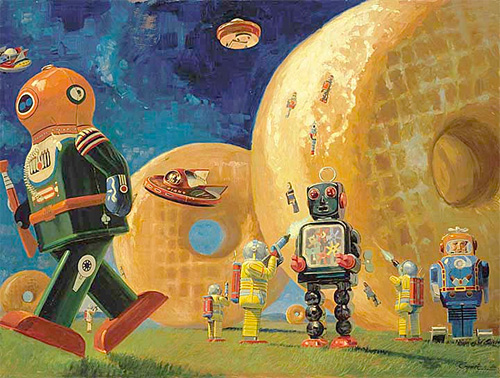
January 24, 2009,
"Glazed" a painting by Eric Joyner
Take a look at Eric's website and
consider buying some prints or a book or something else cool there.
December 13, 2008, Dancing Robots
Robots in the new Motoman Robotics Lab gave a "command" performance Nov. 21 to celebrate their new home.
Dancing robots, directed by a master robot, performed to the "Dance of the Sugar Plum Fairies," the opening to Star Wars and "Mr.
Roboto" to celebrate the dedication of the Motoman Robotics Lab at the University of Dayton, Friday, Nov. 21.
In addition to enhancing the arts scene, the new robots will provide academic and research benefits to Ohio. The new lab could enhance Ohio manufacturing capabilities and provide opportunities for Ohio industry to partner with UD to research new ideas.
Two Ohio companies — SAS Automation and Motoman — already have made investments and contributions to the University valued by the companies at more than $500,000.
UD President Daniel J. Curran, Joseph Saliba, interim UD provost; Don Moon, chair of UD's electrical and computer engineering department; Steve
Barhorst, Motoman president; and Trent Fisher, SAS Automation president, spoke during the dedication in Kettering Labs Room 232.
April 12, 2008, Terminator Series
Review
First of all, I give a "two thumbs up" to the
Terminator TV series. That's no small endorsement as I have very
high expectations for the Terminator line (including the movies).
The time travel stuff is always fun, but of course it's the robotics
that I like. Unfortunately, we know what it is like when humans lack
morality. This series explores super-humans
with no morality. To all future roboticists: Please program Asimov's
three laws into your creations.
Jan 25, 2008, Robot Learning
As mentioned below, only a fifth of the cost of deploying a robot
on a factory floor is the cost of the robot itself. The rest of the
cost is programming the robot, developing the tools and developing
the manufacturing processes. A company called Skilligent is working
to reduce the cost of programming the robot. They announced the commercial release of
a robot learning software. The main concept behind the software is that it can learn skills directly from humans without programming. This opens the door for building robots
that don’t require traditional programming as they can be trained “out-of-the-box” by a non-professional user.
Jan 3, 2008, Indian robots toil on global shop floors
Lower labor cost is the reason often cited for off-shoring
manufacturing jobs. So why would it be cheaper to use robots in
India than in the USA? It's because only a fifth of the cost of
deploying the robot is the cost of the robot itself. The rest of the
cost is programming the robot, developing the tools and developing
the manufacturing processes. It will be a long time before we
automate that part of the equation.
November 28, 2007, University
Programs in Robotics
Q. My students in Middle School would like to know about the list of universities that offer programs in robotics that you are compiling. Can you share what you already have? I don't want them to email strangers on their own. Thanks.
A. The term robotics has become so broad that it now applies to just about any electro-mechanical system. I think every University in the country that has an undergraduate engineering program also does something in robotics.
Here are some schools that have graduate programs in robotics: MIT, Stanford, CMU, UTexas Austin, UTexas
Arlington, UFlorida, UMichigam, UTennessee, USC, UWashington,
UHawaii and Georgia Tech. I'm sure there are many more.
Your students might like to read Rossum's Universal Robots by the Czech writer Capek. That's where the word robot comes from.
October 22, 2007, I can't
resist a plug for my Alma Mater
A team of faculty and students from Rice and Freie Universität Berlin researchers hopes to vie this November for the $2 million prize in the prestigious international robotics competition "Urban Challenge," sponsored by the Defense Advanced Research Projects Agency (DARPA).
http://www.media.rice.edu/media/NewsBot.asp?MODE=VIEW&ID=9982
August 30, 2007, University
Robotics Programs
I'm compiling a list of Universities that offer programs in
robotics or mechatronics. I'd appreciate any input to help with the
list. email Rich
August 1, 2007, Robotics Job
Opening
Rich,
We have a client in the Automobile industry who is seeking several
candidates for the following position: Paint Robotics Technicians
Anyone who'd like to apply can e-mail their resume to me at ...
See the learn about robotics jobs page for more information.
http://www.learnaboutrobots.com/roboticsJobs.htm
April 18, 2007, Robot Bill of
Rights?
A robot bill of rights is as silly an idea as I've heard in
a while. The robots we are envisioning for at least the next 50 years are computer-controlled electro-mechanical systems. These machines deserve no more rights than vacuum cleaners. We'll treat these robots a lot like cars. They'll be expensive so we'll insure them. As they get older and older they'll be worth less and less. Eventually the robot will break or be damaged so much that it won't be worth fixing. Then it will be off to the junk yard. Robots with any sort of self-awareness on the level deserving of rights aren't even on the drawing board yet. Fruit flies with less than twenty neural connections can fly, avoid obstacles, find food and mate (however it is that fruit flies mate). Fruit flies deserve a bill of rights more than robots do. My opinion is that robot "brains" made of computational machinery that transmit only electrical or optical signals will never achieve self-awareness or be deserving of rights.
Beyond 50 years out we might start seeing androids that take advantage of chemical transmitters in their "brains" for a computational architecture that is orders-of-magnitude more sophisticated than the computers we have now. Even more interesting would be rights for cyborgs that combine biology with electro-mechanical systems. I can easily imagine an electro-mechanical dog with a real-dog's brain transplanted into it. What sort of rights would that have?
March 18, 2007, Who is really
thinking about robots these days?
I had an interesting phone call the other day with a writer for
the New York Times magazine. He was wondering where innovation
in robotics was taking place and mentioned the Darpa Grand Challenge
as a point of interest. I think the
Darpa Grand Challenge promotes a great deal of engineering
innovation, but robotics innovation? The challenge is everything but
grand. A common ant can get around by
itself. Ants identify targets, work cooperatively with other ants,
find food and mate. That's infinitely more than any of the vehicles in the
Darpa Grand Challenge. My opinion is the Darpa Grand Challenge
vehicles are far below common ants in robotic achievement.
So who really is innovating and thinking about robots these days?
Are there still people thinking on the level of Huxley, Asimov
or Capek?
March 2, 2007, Do you have
any experience making androids? Email question
I don't have any experience making androids. I do have some experience making humanoids. They are
usually easy to make. After that it's at least 21 years of work to make them human. I know because I am working on three of my own.
I expect making androids would be similar. They would be on the easy side to make, but would take
a lifetime to teach. My favorite android is Commander Data from Star Trek Next Generation. The android astronauts in the Alien movies are also pretty cool.
Feb 25, 2007, Robocide is
not allowed. I'm not the only one that feels this way
"It was inappropriate to use depression and suicide as a way to sell cars," said Robert
Gebbia, the executive director of the American Foundation for Suicide Prevention.
Feb 04, 2007, 2007 - GM
Super Bowl Robot Commercial Tragedy Violates the 3rd law
I like robots and robotics. I do not like this commercial. I
believe the image of a robot throwing itself off a bridge and
committing robocide is irresponsible. What if a person loses
their job because they dropped a bolt? Should that person jump off a
bridge too?
Maybe GM is implying the robots and people that work at GM are so
bad that the only other jobs they could get would be waving signs or
holding speakers?
Asimov's Third Law of Robotics - "A robot must protect its own existence as long as such protection does not conflict with the First or Second Law."
Is GM implying that robots must start destroying themselves to
protect humans? That is the only way this commercial could comply
with the third law - even if the robot was just
"dreaming."
Jan 29, 2007 - Plumber or
engineer? Email question
Hello, I am currently a 17-year-old high school student in Alberta. I am very interested in becoming a robotics engineer. The thing is I'm not sure if robotic engineering is really what I believe it's going to be...Maybe you can guide me. I am planning to go to UofA (University of Alberta) http://www.ualberta.ca/ and then taking the courses I need to get a PhD in Robotics Engineering: http://www.engineering.ualberta.ca/ (I'm not sure if they offer that course)
After I passed the requirements, I would maybe like to get some experience maintaining robots/get hired for robotics designs around Edmonton and Cold Lake (Northwest of Edmonton): http://www.1clickhotels.com/maps/Alberta%20Map.gif
My real goal though would be to start a project kind of like Kiberton: http://www.kibertron.com/ Except maybe get some funds from somewhere like Honda, the government or the Canadian Forces (I'm planning to either be the designer of a big android project for civilian/commercial or industrial uses or possibly, hopefully a military project.) High hopes eh? How much chance do you think I have at succeeding? Do you think I can do it by going to UofA? Would I be obligated to move around the country? Is it a good job for supporting a family?
Thanks alot, I really hope you can help me
PS. My friend and I were having this debate. He's going to go in trades and become a plumber/electrician. I said I was going to go to university and become an engineer. He says that I'm going to waste 6 years, he'll be filthy rich, he'll be able to retire when he's young and I'll spend all my life trying to make as much money as he could. Is this true?
According to Rich - Thanks for the thoughtful email. First of all, I recommend that you go the
university route. It will not be a waste and you will learn a lot. You will
not regret that choice.
Can you make more money in engineering or in the trades? Understand that
neither engineers nor "tradesmen" are going to make a lot of money on the
ground floor. Going the trades route, you can start your own business and ultimately have a number of plumbers, electricians, etc. working for
you. If that sounds interesting, you might go to a university and study business. As
an engineer you can also start your own business and have other engineers
working for you. Or you could work at a bigger company and have a number of
engineers reporting to you (I have about 15 engineers reporting to me). Either way,
as you grow in your career you will be more successful if you learn to coach, mentor, leverage and direct
others.
Did I mention that I recommend the university route? That’s not the only way, but you will have more options.
PS I asked my son what he thought about your email. Here’s how he replied:
According to Rich's son - Well, you'll have to work with the questions appertaining to the job itself
(ie. Moving around the country,
having a family. Then again, I guess you are a robotics engineer, and I am your son. So that would answer
the family question.)
But I think he should know that, at least to me, it seems like a questionable idea to create plans for a future
based upon a certain string of events happening without flaw - making it into
UofA, then earning a PhD, then
getting a job in robotics, and at last coming up with his wonderful android or military project. If he is truly
interested in robotics for the field itself, then this plan will certainly bring him to a sense of
contentment/fulfillment, despite any changes in the plans that may occur along the way. However, if his only,
or at least main, incentive for pursuing this career path is to end up in the final scenario he's listed here, then
he may need to reconsider. What if the PhD doesn't go as planned? What if he isn't able to land a job on a
major project right off the bat? Also, his specific interests such as these may change. He needs to ask
himself if he's really interested in the field of robotics, and not only in completing the path he's outlined here.
If the answer is yes, and an outline is all this is, and he is truly willing to go forth with this, then I'm sure he
could be happy as a robotics engineer.
As for his debate with his friend... I'll let you handle this one. If all his friend can think about is how to do him one better by
becoming fat and happy first, then I really haven't got anything to say.
Jan 11, 2007 - How do I
find a job in robotics? Email question
I get emailed this question more than any other. I would say a
“job in robotics” means you are getting paid to design, build,
deploy or maintain robots. So what industries design, build, deploy
or maintain robots? The answer to this depends a lot on how we
define “robot.” There are six-axis industrial robots used in the
auto industry, wafer handling robots used in semiconductor
manufacturing, robotic surgeons, robotic airplanes, robotic vacuum
cleaners and the list goes on. I call it robotic if it is a
computer-controlled machine with moving parts. Based on that
definition, there are companies that design, build, deploy and
maintain robots in just about every industry you can think of. There
are companies that make robotic products and there are companies
that do custom robotic systems. I'm sure you can find them using
Internet searches or by networking with people you know. I don't
personally recommend any one company over another.
Building, deploying and maintaining robots could be very
interesting. You would be on the "ground floor" working
with robots every day. To get started a person might consider a
technical college degree. Networking with people you know or have
worked with in the past is always a good idea. Somehow you will need
to demonstrate by experience or training that you are qualified.
To get a job designing robots or robotic systems you are almost
certainly going to need a four-year engineering degree. Many
robotics engineers will have Master’s degree and there are plenty
of PhD’s around. You also need to understand that when you first
graduate college, even with a Master’s degree, you will be a very
junior engineer. Robotic systems are typically the most complex
systems a company will make. You will need to first focus on a
subsystem, such as the mechanical, electrical, computing or software
systems. Once you have become an accomplished engineer in one of
those fields, you can move up to the more advanced systems
engineering role.
November 4, 2006 - Snake
Arm Robot
For assembly in tight places
This is a "snake" extension to a standard industrial
robot. It looks to me like the snake section has about ten segments.
The long thin profile allows it to work in tight places with the
initial applications being inspection and sealing inside of aircraft
wings. The long thin profile will also make it pretty flexible and
limit it to applications requiring low precision. There is a picture
of the actual system on the lower, right-hand corner of the page.
October 14, 2006 - Remote
Controlled Robotic Medic
The Bear
Bear stands for Battlefield Extraction And Retrieval. This is a
remote controlled walking robot designed to pick up and carry
wounded soldiers to a safer position. It has a very high payload
capacity of 500 pounds but the cool thing is that it can travel on
it's feet, knees and even while practically lying down and still
carry its payload. I can easily envision this technology being
extended to civilian applications such as search and rescue in
burning or unstable buildings. I wonder if the Bear could carry
heavy fire hose into buildings?
August 31, 2006 - Linux-powered robots from France?
Oui!
A French start-up created to build autonomous, easily programmable, affordable humanoid robots has emerged from stealth mode. Aldebaran Robotics, of Paris, expects to ship its first product -- a humanoid household service robot running Linux -- in early 2007.
August 23, 2006 - Robotics Job
Opportunity Came by email
Job Summary:
Develop original algorithms and software code to produce practical solutions to unsolved problems in the deployment of outdoor mobile robots.
Essential Functions:
* Program robotics platform using C/C++
* Develop creative approaches and algorithms in order to minimize the need for sensor input
* Work with a team of 3-5 other engineers in the development of the software and robotic platform
* Work with technical product manager to ensure all customer requirements are met effectively
See the Indy
Robotics website for more information
August 9, 2006 - Robotics Job
Opportunity
Dear Richard,
We are currently helping a client fill the following position:
Position: MES Consultant - OSISoft,
Job Id: 4492
Job Location: Northeast
Job Type: Employee
Description:
Are you looking for challenging assignments and opportunities for personnel growth in a collaborative and team-oriented environment?
Our client is a Manufacturing Consulting and Systems Integration company specializing in MES applications and any other projects that require knowledge in both Information Systems and manufacturing processes. They are currently seeking a MES Consultant specializing in OSISoft for projects in the Life Sciences industry.
This company offers a flexible and open work environment focused on client satisfaction and employee growth through the practical application of advanced systems technologies to solve mission critical problems. They invest in their employees through training and development so that they can deliver maximum value to our customers.
This individual will work in a growing IT consulting organization focused on delivering manufacturing and supply chain system solutions. Duties will include leading or participating in consulting engagements, as well as helping clients define, justify, plan and implement technology solutions for manufacturing and supply chain environments across the U.S. and Canada.
The position can be based anywhere in or near the greater Philadelphia or mid-Atlantic area. The job requires travel to client locations on a periodic basis.
Successful candidates will possess some or all of the following experience and qualifications:
• Experience in the design, configuration, implementation, and integration of manufacturing or supply chain systems.
• Hands-on experience designing and implementing OSISoft solutions, specifically PI Batch and PI Data Warehouse implementations
• Bachelor’s degree or higher is preferred
• Experience in applying industry standards (such as SCOR, ISA S88, and ISA S95)
• Strong verbal and written communication skills
• Willing to travel extensively within the US.
• Experience in the Life Sciences (pharmaceutical, bio-tech, etc.) industry is preferred.
July 12, 2006 - Omnibot
"Vintage Robot"
The Omnibot was a cool little robot made in the
mid 1980's. For you vintage robot collectors, this site has some
parts you might be able to use.
May 5, 2006 - Amazing
Walking Robot
I don't how long the batteries last or any details, but this is
really something to watch.
March 10, 2006 - Liquid water on Saturn moon Enceladus
may well support life
The most exciting discovery imaginable. We should send a robotic
spacecraft to investigate as soon as possible. Can someone please
tell GW Bush that we've already sent people to the moon? He must not
be aware of that because he's making a big deal of his plans to send
people to the moon. That's diverting much-needed funding that should
go to robotic missions.
May 2, 2006 - Robotics Job
Opportunity
Dear Richard,
We are currently helping a client fill the following position:
Position: Automation Software Engineer - Richardson, TX [4299],
Job Id: 4299
Job Location: Richardson, TX
Job Type: Employee
Description:
Our client is small but rapidly growing manufacturing company. They are currently seeking an Automation Software Engineer. This individual is responsible for maintaining current and developing new system control software for products. Responsibilities include:
- Identify, specify, architect, develop, test, integrate, and support software control system & software user interface (UI) for existing manipulation/robotics system products.
- Responsible for automation software of manipulation/ robotics system products.
This person will work with other Software Engineers serving primarily in a hands-on technical role generating revenue through aggressive product development, and secondarily, helping to secure new business via application development with process engineers & scientists.
To qualify, you must have a BS in Engineering, Computer Science, Math or other related field from an accredited university. MS preferred. 7+ years of product development and support experience in automation & robotics system solutions required. Advanced knowledge of C#, .NET and C++ is required along with a broad skill set and experience in software & control system architecture. Motion control and vision analysis experience is preferred. You must also have the following required skills:
Knowledge of applications and associated manufacturing techniques for manufacturing automation systems
Experience developing and managing suppliers/vendors
Ability to quickly learn new technical concepts
Ability to work within a project plan, adhering to the plans goals and milestones
US citizenship or Permanent Residency is required for this position
Fluently speak, read and write English
Good technical communication skills both writing and speaking
Basic skill level using Word, Excel, & PowerPoint
Exercise reasonable judgment (without supervision)
Detail-oriented
Organized
Self-starter
Team player
The Company offers a competitive compensation and benefits package, including medical and dental insurance, stock options, incentive compensation, 401k and more.
*******************
If you or anyone you know are interested and feel you are qualified for this position, please contact us by sending a copy of your resume in WORD format.
We hope to hear from you,
Stephanie
March 10, 2006 - Liquid water on Saturn moon Enceladus may
well support life
The most exciting discovery imaginable. We should send a robotic
spacecraft to investigate as soon as possible. Can someone please
tell GW Bush that we've already sent people to the moon? He must not
be aware of that because he's making a big deal of his plans to send
people to the moon. That's diverting much-needed funding that should
go to robotic missions.
February 17, 2006 - Job
Opportunity - Interested candidates please send a resume to
jennie.gardino@framatome-anp.com
First let me thank you for your site - I
personally have learned more about telerobotics (and robotics) in the last hour on your web site then I thought I would ever know and understand.
Second - the reason I was looking to begin with is that I have been asked to help source candidate for a
Telerobotics Tooling Engineer opening. (I have put the details below.) I'm assuming with your network that
occasionally people asked you for career leads - I would hope you would be willing to pass the below information along in that case. It would be much
appreciated.
Telerobotics Tooling Engineer
Framatome ANP (Advanced Nuclear Power), an AREVA and Siemens Company, is the world's premier nuclear supplier. Framatome ANP's focus includes comprehensive engineering, instrumentation and control, nuclear services, heavy component manufacture, modernization, fuel assemblies for many reactor designs, and the development and construction of nuclear power plants and research reactors.
We are looking for a Tooling Specialist to design machined and welded components for complex Tele-Robotics systems in our CR&R organization in Lynchburg Va. This team provides turn-key component design, replacement and remediation services for nuclear power plant primary system components. Engineers will perform machine tooling design and equipment design used in the replacement of RV Heads, Steam generators and other primary system components. The selected individual will be responsible for the entire life cycle of the tooling, from concept, detailed specification, design, testing through implementation into remote, hazardous locations. Design cycles have very short lead times. This design engineer will work on exciting, multi-million dollar design projects and emergent work using 3D modeling techniques to design detailed tooling and machined equipment used in telerobotics and TWS systems. Design projects vary according to customer needs and are typically first-of-a-kind projects. Candidate must be able to design tools that are leak proof, corrosion resistant, etc… for remote hazardous locations.
Engineer must travel to utility customers during implementation of equipment and tooling during outage seasons, so qualified candidate must be able to obtain access to nuclear facilities. Travel can be up to 4 weeks at a time, usually in the spring and outage seasons. Engineer may be called to site to address any issues that are encountered with their equipment.
Requirements: B.S. degree in Mechanical Engineering OR Mechanical Engineering Technology required with min. of 5 yrs relevant design experience in 3D CAD Modeling and machined tooling design. Prefer candidate that has SolidWorks 3D CAD Modeling experience. Design experience for robotic applications ideal. Must be able to provide examples of 3D CAD drawings. Geometric dimensional tolerancing knowledge required and experience with machining and welding processes preferred.
Interested candidates should submit resume with “ToolingEng” in subject line to:
February 6, 2005 - Job
Opportunity - Interested candidates please send a resume in Word
format to sdwyer@automationtechies.com
Position: Applications Engineer - Any TX Location,
Job Id: 4229
Job Location: Dallas, TX
Job Type: Employee
Our client is a distributor and value added reseller of Industrial Automation Products. They are currently seeking an Applications Engineer to support their sales of Robotics and Motion Control products.
Candidates should have at least a 2-year technical degree and 5 years of work experience, or a 4-year technical degree and 3 years of work experience. Experience working in a similar role is a plus.
The job will be based out of Dallas, TX, however we will take applicants from elsewhere in Texas since the customer base will require traveling throughout the state.
December 21, 2005 - Passfaces
This
company has a pretty cool idea to add an additional layer of security to traditional login and password user verification.
I recommend giving it a try at the above link by clicking the "Try
Passfaces."
It's kind of fun. The system makes use of our brain's natural
ability to recognize faces. Basically, you pick your passfaces out of
a crowd to verify your identity. There are a lot of benefits to this
approach. You can't write your passfaces down, you can't tell them
to someone else, they can't be phished and they are very hard to
steal.
December 18, 2005 - These Technicians Are Better Than Robots
Japan is turning to hyper-skilled supaa ginosha, or super technicians, to preserve its manufacturing edge
Behind the locked doors of a Sharp Corp. (SHCAY ) factory in the central Japanese city of Nara, Rina Masuda spends her days at a task most people would find both mind-numbing and infuriating. With the searing tip of a soldering iron, she guides droplets of molten metal on a circuit board to the edges of a microchip. In less than a minute she has the chip standing on dozens of tiny metal legs separated by a hair's breadth to keep electrons flowing smoothly. Masuda's job seems at odds with the bank of machines just a few yards away that spit out hundreds of circuit boards every hour. Yet Masuda doesn't fear losing her job to automation, at least not until the equipment is as precise as she is. When the machines botch a job, she's called in to fix up the chips. "The soldering I do by hand is far superior to anything the machines can do," says the 33-year-old.
August 20, 2005 -
Entertainment & Humanoid Robots
I
recently had a question about entertainment and humanoid robots in
the US. It seemed to me that most entertainment robots in the movies
these days were computer-generated. For actual and physical
entertainment robots, I bet the Disney imagineers do it as well as
anyone.
As
for humanoid robots, I'm not sure who is working on that kind of
beast. Maybe Rodney Brooks at MIT? Marshall Brain certainly talks
about them. I don't know if he is building any of them.
Anyone
out there with information, links, contacts, etc. about
entertainment or humanoid robots in the US, please send it in and I
will be happy to post it.
July 26, 2005 - Motion
Control Is Robotics - Job Opening
Dear
Richard:
We are currently helping a client fill the following position:
Position: Motion Controls Engineer ,
Job Id: 3926
Job Location: Dallas, TX
Job Type: Employee
Description:
Our client is a Systems Integrator based in Texas, with offices around the country. They are looking for a controls engineer with extensive experience in a variety of motion control platforms.
-BS Degree in Engineering
-Wonderware/ControlLogix/Allen Bradley-SERCOS Motion
-experience with Kinetix SERCOS would be a plus.
-Interpersonal skills and project management is a big plus.
When applying please list the different types of motion controllers, servos, or steppers you have experience with.
*******************
If you or anyone you know are interested and feel you are qualified for this position, please contact us by sending a copy of your resume in WORD format.
We hope to hear from you,
Kristy
July 23, 2005 - Robot
Camel Jockeys "I almost could not believe it"
The
robots were developed after the United Arab Emirates Camel Racing
Association banned the use of jockeys under the age of 16 in March
2004 (they increased the age limit to 18 in July 2005). It may sound
crazy, but if it is helping to keep children out of dangerous
situations, then I'm all for it. Human operators carrying handheld radio units, in a convoy of sports utility vehicles, following ten camels each with a remote-controlled mechatronic jockey must have been something to see. I wish I had been at
that racetrack in Abu Dubai.
July 3, 2005 - "Robotics
Job Opening"
Rich, I need a software engineer who understands robotics. We make semiconductor process systems that employ servo motors and some pneumatics to process and handle the wafers. We are located in Northern New Jersey and I need a good reliable guy. Can you help. To see what we do visit our web site at www.s-cubed.com Thank you. Gary Hillman 973-263-0640
Dear Richard,
We are currently helping a client fill the following position:
Position: Manufacturing Process Engineer-TX8802,
Job Id: 3881
Job Location: El Paso, TX
Job Type: Employee
Description: Manage and participate in new technology development and automation projects targeted to support corporate key initiatives. Work closely with R&D, Technology Development, and Software Engineering team members to develop and deploy state of the art production manufacturing equipment. Design process control strategies to support quality improvement goals and objectives using SPC and Six Sigma methodologies. Maintain and support daily production equipment uptime requirements. Works on significant and unique issues where analysis of situations or data requires an evaluation of intangibles. Exercises independent judgment in methods, techniques and evaluation criteria for obtaining results. Contacts pertain to significant matters often involving coordination among groups.
REQUIREMENTS
-BS in Electrical or Mechanical Engineering
-7+ years hands on experience directly related to state of the art Machine, Robotic and Material Handling Automation in R&D or Production Engineering.
-5+ years experience managing automation related projects.
-1-3 years SPC / Six Sigma training and experience with Six Sigma Green Belt preferred.
-Robotic Programming
-Experience working with minimal supervision and directing resources.
-Project Management
- Must posses the ability to effectively communicate in both oral and written form with emphasis on requirements and specifications. In addition must have the ability to report project status accurately and timely to Manager level.
Contact lreitz@automation.com if interested
April 30, 2005 - "Finally,
A Reasonable Plan to Service the Hubble"
I
read in the paper today that the new NASA chief is thinking aloud
about a shuttle mission to service the Hubble. As I've said before
on this site, I consider the Hubble
Deep Field images to be some of the great contributions of human
kind. As much as I love robots, I believe that it makes the most
sense to use astronauts, rather than robots, to service the Hubble.
A number of my good friends in the robotics field feel otherwise.
Here's a report from Dr. Craig Carignan of the University of
Maryland Space Systems Laboratory that I've previously posted:
"In the Space Systems Laboratory at the
University of Maryland, we have developed a highly capable robotic
system called Ranger which has performed several Hubble servicing
tasks in neutral buoyancy, including changeout of the electronic
control unit (ECU) and batteries, as well as tasks supporting the
replacement of radial instruments such as the Wide Field Camera and
Fine Guidance Sensor. These tasks involve grabbing handrails,
unscrewing bolts, removing large modules, and installing connectors,
all of which are EVA "friendly" but still require a high
level of dexterity."
April 20, 2005 - "Robotics
Job Opening"
Aerotek’s
Automotive division has an immediate opening for a Robotic
Installation Engineer. You must have previous work experience
installing and programming Fanuc robots. Installations will
take place at automotive suppliers throughout the country.
This position requires between 80-100% travel and salary is
negotiable. This is a contract to hire position. If
interested in the position please email Jim Wellington at jwelling@aerotek.com
March 29, 2005 - "How
Do I Become a Robotics Engineer"
I get emailed this question two or three times a
week from people in elementary school, high school, college or
graduate school. I'm trying to develop some thoughtful and
age-appropriate responses to post on the site. I would really
appreciate it if anyone would like to send in their own experiences.
That will help me give a broader perspective.
March 20, 2005 - Darpa
Grand Challenge "What will it be this year?"
Last year I predicted that no team would even come close to finishing (March 11, 2004)
http://www.learnaboutrobots.com/archives.htm
I was right then and I'll go out on the same limb now. No team will
make it even half way. There is a $2Meg prize, but that is a pittance compared to what these teams are spending. Clearly they are doing it for more than
just the prize money. There's the fame, the glory and as Red Whittaker told me himself, “never spend your own money…”
Feb 11, 2005 - Shaking
Hands with a Robot "Robotic Hands"
This is a fantastic article that primarily
discusses haptics (a category of technology that allows users to
“touch” or “feel” virtual objects via mechanical simulation),
but also considers some of the affects of robots on society. The
difficulty associated with haptics has to do with the frequency
response of the feedback mechanism. Typical robotic systems have a
first mode around one Hertz. This means that if you try to command
them to do something faster than about once a second they'll either
start vibrating or will just ignore the command. To convey a sense
of touch, such as the texture of a surface, the frequency response
has to be around 100 times better than that. I find it interesting
that the very early telerobotic systems
developed during the 1940's had superb haptic feedback because of
their purely mechanical nature.
Feb 8, 2005 - Austin
Team in the Darpa Grand Challenge "Will this year be
different?"
Last year I predicted before the Darpa challenge
competition that no team would even come close to making it. I'm
still working on a prediction for this year. Austin, Texas (the town
I live in) is represented by a team this year. I've been helping
them with their safety strategies. I would love to participate more,
but time is pretty short these days.
January 28, 2005 - New
Robot on the Space Station "This one was built by
Germany"
They've got the robot up to the space station and
installed.
December 16, 2004 - Robot
Going to the Space Station "This one was built by
Germany"
I'm becoming more and more convinced that the
only reason to send people into space is to study the effects of
people being in space. Between robots, automation and remote
control; there really is no need for humans to control the spaceship
or conduct experiments.
December 11, 2004 - Jellyfish
Robot "It's only $29K"
A Japanese firm said it has created a jellyfish-shaped robot that can alert homeowners to burglars or
house-sit for their pets. When not at work, it can lounge about and be "beautiful."
Just like me.
December 05, 2004 - But
What About the Eels? "Replicating an Eel’s Nerve
Circuitry May Aid Paralyzed People"
This does not have much to do with robotics, but
it's still pretty cool. These scientists are studying the nervous
system of the Lamprey eel to try to learn how the creature controls
its locomotion. They then want to use this knowledge to help people
with spinal cord damage.
December 02, 2004 - Watch
Out for Cats "New robot uses real mouse whiskers to navigate tight quarters"
I'm pretty sure I don't even want to know how they go the real mouse whiskers. This effort follows along the lines of making robots that mimic biology. I find it interesting that the whiskers not only sense when the robot bumps into things, but they can also sense vibrations in the ground and air.
November 15, 2004 - Neuromorphic
Engineering "Combining Electrical Engineering and
Neurobiology"
This approach to machine vision uses a computing
architecture modeled on a fly's brain. A common fly has a brain
about the size of a sesame seed with only about a million neurons,
yet the fly is an autonomous creature that finds it's own food;
mates; and , well, flies. In many ways these behaviors are far
beyond the capabilities of even the most advanced of today's robots.
October 15, 2004 - Robot Machine Gun "You
would not want to see one of these rolling towards you"
This is not really a robot. It is a
remote-controlled vehicle on tank treads that also sports a
remote-controlled machine gun. It is a take on the remote controlled
reconnaissance vehicles they use to search in caves and such. They
can also mount rocket launchers on these things. Given the
military's budget and the rapidly-progressing state-of-the-art in
robotics, we are going to be seeing some very scary robots in the
very near future.
September 24, 2004 - Austin,
Texas Engineering Jobs "Very low BS factor"
The company I work for is trying to hire some
electrical engineers, mechanical engineers, software engineers and a
project manager. I think it is a great place to work. There is a
constant supply of very high tech and interesting projects. We have
very few meetings and no Dilbert managers. Email me your resume and
a short note if you are interested. I posted the job descriptions on
the page linked to above.
September 15, 2004 - Robot Venus Fly Trap
"Maybe if they could make it catch mosquitoes..."
The article describes a small robot that generates
its own power by catching and digesting flies. Of course the power generated by digesting flies is quite small so the robot moves very slowly. I think they should make a robot that catches and digests mosquitoes. Here in Texas mosquitoes are a big problem. People even install "misting systems" that essentially blast their whole yard with insecticide on a pre-programmed basis. The robot would not even need to move around the yard. In fact, it would not even need to be a robot. It could just sit out in the far corner of the yard digesting mosquitoes. It would use the energy from digesting the blood-suckers to generate carbon monoxide to lure more mosquitoes. In Houston that would be a virtual perpetual energy machine.
September 1, 2004 - Robot Foosball
"So now robots are going to hang around in bars?"
I can't decide whether this is a robot or not. No matter, Foosball was
one of my favorite games growing up so I have to write about this one.
These researchers at the University of Freiburg in Germany connected
the rods on one side of a foosball table to high-powered motors and
an electronic control system. The bottom of the table is made from a
see-through green material and underneath is a camera that scans the
position of the ball and then sends the data to a computer. The computer is preprogrammed with knowledge of the dynamics of the ball,
the rules of the game and a goal of hitting the ball towards the opponent's side of the table. So far the robot system can't come close
to beating an expert player, but the makers of the system claim that
they will be the world champs within five years. I'm not so sure about
that. Foosball is not all about reflexes and tracking. A good portion
of the game is anticipating the moves of your opponent. I have another
question. Who is funding this research? I want some too!
August 12, 2004 - Job Opening
"Telerobotics Tooling Engineer"
I got this inquiry via email and thought it would
be easiest just to post it on this site. Areva Framatome is looking for a Tooling Specialist to design machined and welded components for complex Tele-Robotics systems.
July 22, 2004 - I, Robot "I'll
give it a 2 out of 5"
I'm going to give away some of the plot twists in
this review, so if you have not seen "I, Robot" you may want to
quit reading now. I did enjoy watching this movie, but then again, I
enjoy most everything about robots so that is not saying too much.
The movie has boatloads of action and armies of cool robots, but it's obvious
the three laws of robotics are just shoehorned in. They should have
called it "2001: A Space Odyssey Remade into a Summer Blockbuster,"
because the basic premise behind "I, Robot" is that a central computer goes out of control and
decides it's ok to kill humans. They try to fit in the Asimov's
first law by saying that the computer is saving humanity from itself
by killing-off a few bad apples; thus still following the first law.
This is one of the things that really bugs me about this movie. They
get the first law wrong. The first law states that a robot may not
injure a human being. Not even one. Not for any reason. The robots
are constantly trying to kill Will Smith and somehow that is still
following the first law? Preposterous. Speaking of preposterous,
hundreds of robots go after Will Smith, platoons of them at a time,
and somehow he beats them all off. They would have easily gotten him
halfway through the movie. In the final scene the robots are
swarming around Will and the obligatory babe/possible-love-interest
like a swarm of mad bees and of course the heroes make it. Just
writing this review is making me like the movie less. That pretty
much sums it up. This movie was fun to watch, but afterward I
started liking it less and less.
Since I'm ranting about robots and movies. I'll
give you a list of my favorite robot movies in roughly chronological
order. Note that "I, Robot" does not make this list: Metropolis, The Day
the Earth Stood Still, 2001: A Space Odyssey, Silent Running,
Sleeper, Westworld, The (original) Stepford Wives, Star Wars, Alien, Blade
Runner, The Terminator, Robocop and A.I.
July 15, 2004 -
The Omnibot was a cool little robot made in the
mid 1980's. For you vintage robot collectors, this site has some
parts you might be able to use.
July 7, 2004 - Hospitals turn to robot couriers "I'm not sure about this one"
These are essentially delivery units that can
bring around mail, meals and maybe a clean pillow. I'm not all for this application of robots.
There's a human element to hospitals and people can really make a
difference. I've been in the hospital a time or two due to being a
pretty accident-prone kid. Those few visits by the nurse or the guy
with the meals really helped break-up the day. They would chat for a
couple of minutes and ask how you were doing. Rolling robot cabinets
just are not going to have the same effect.
June 30, 2004 - Robot
Floor Scrubber "Entrepreneur Henry Hillman Jr. starts yet another venture"
I like this application. These robot floor
scrubbers can clean thousands of square feet of commercial space.
They are replacing what has to be a horribly boring job for humans
and the autonomy challenges are not too great. Basically, a perfect
job for robots!
June 19, 2004 -
It's
Official "NASA proposes to award a sole-source contract
for robotic servicing of the Hubble Space Telescope"
It's not quite the National Enquirer, but for me,
this is a pretty good scoop. NASA’s Goddard Space Flight Center (GSFC)
intends to issue a SOLE SOURCE Request for Proposal (RFP) to MD
Robotics for the development of a robotic grapple arm and a
double-armed dexterous robot that would be needed to accomplish the
hardware exchange during a potential space-flight mission to service
the Hubble Space Telescope (HST), called the HST Robotic Servicing
and De-orbit Mission (HRSDM).
MD Robotics are the folks who
developed the Canadarm robot arm, a version of which has flown on
every Space Shuttle flight for the last twenty years. The arm has a
shoulder with 2 DOF, an elbow with 1 DOF and a 3 DOF wrist. It is
routinely used as a mobile work platform for the astronauts, for
"tossing" satellites into space and for retrieving faulty
ones. Non-routine uses have included: knocking a block of ice from a
clogged waste-water vent, pushing a faulty antenna into place, and
activating a satellite that failed to go into proper orbit. Several
of these arms have been in service for twenty years.
That being said, why on earth is this a SOLE
SOURCE RFP!? There are plenty of other robotics companies that
should at least be allowed to bid on this project.
June 15, 2004 - Robotic
Space Servicing "Will robots service the Hubble?"
Craig Carignan of the University of Maryland
Space Systems Lab sent the above link to a cool robot animation. He
writes, "In May, 2004, we were offered an opportunity to integrate the Ranger dexterous arms into the rendezvous and docking simulator at the Naval Research Laboratory for some joint tests, which simulate a spacecraft flying up to a satellite, grappling the berthing bars on the aft bulkhead, then performing an electronics box changeout. This test had a very short turn-around
time, and the Ranger team deserves a great deal of credit for making it happen."
There's some more information on the Ranger here.
May 20, 2004 - FDA
Approves Miniature Back Surgery Robot "The European Union has also given its CE approval for the robot"
At only $100,000 this robot seems curiously
inexpensive. I would think $100K/robot would barely cover the
liability insurance. In any case, this is just the latest in what is
sure to be a continuing trend of robots in the operating room. I've
already reported on robots participating in open-heart surgery,
brain surgery and now back surgery.
May 11, 2004 - Robots
Are Our friends "I've been saying this all along"
This article discusses how robots in the movies
almost always transform from fearsome creatures into our friendly
servants. I like to use the Terminator example. In the first
Terminator Arnold was a killing machine dispatching humans with
wanton abandon. Towards the end of the movie he was one ugly mess
with rotting organic skin full of bullet holes - but still killing
humans at full-throttle. At the very end he was barely able to crawl
and ultimately crushed in a machine press. By the third Terminator
he was a Hollywood hunk doing his best to save humanity. I took the
paragraph below directly from the article above. Hopefully this will
entice you to read it.
"When Mary Shelley's Frankenstein first lays eyes on what his science has wrought, he thinks, "I had gazed on him while unfinished; he was ugly then; but when those muscles and joints were rendered capable of motion, it became a thing such as even Dante could not have conceived." When Boris Karloff wakes up in James Whale's "Frankenstein" (1931), however, the audience, primed for horror, is actually relieved; the forehead's on the massive side, and those things sticking out of his neck are a little unfortunate, but he's not so bad, considering. And by the end of the picture we've become so used to the monster's ungainly appearance that he's hardly scary at all: he's kind of likable."
April 16, 2004 - Robots
Can Service the Hubble "Today we have a guest
commentator."
The article at the link above discusses
robotic options for servicing the Hubble space telescope. This idea
has generated quite a bit of controversy. In March's IEEE Spectrum
Anne Kinney said that the task was not feasible for robotics. A few
days ago I wrote that we should just use the shuttle missions
as previously planned. The following is a differing opinion from a
friend of mine.
"I read with great dismay Anne Kinney's remarks regarding an all-robotic servicing mission of Hubble as being "unfeasible" and "beyond the state of the art" [see "Can the Hubble Space Telescope Be Saved", March]. The statement that today's robots are incapable of making "delicate repairs" is simply not accurate and does a great disservice to the community of engineers who have been working on robotic servicing systems such as
"Robonaut", "Ranger TSX", and "CanadArm/SPDM" to name just a few.
In the Space Systems Laboratory at the University of Maryland, we have developed a highly capable robotic system called Ranger which has performed several Hubble servicing tasks in neutral buoyancy, including changeout of the electronic control unit (ECU) and batteries, as well as tasks supporting the replacement of radial instruments such as the Wide Field Camera and Fine Guidance Sensor. These tasks involve grabbing handrails, unscrewing bolts, removing large modules, and installing connectors, all of which are EVA "friendly" but still require a high level of dexterity.
While we cannot do a complete fourth HST servicing mission robotically (at least not yet), we have demonstrated the most critical robotic servicing tasks (battery and rate sensor
changeouts) needed to extend Hubble's life expectancy to a planned deorbit after the James Webb Space Telescope
(JWST) comes online. After seeing such a comment, it makes me wonder if the NASA scientific community is really unaware of the true state of the art, or it just views HST and JWST as a zero sum game – one in which they have already clearly picked the winner."
Craig Carignan, Adj. Prof.
Dept. of Aerospace Engineering, University of Maryland
April 15, 2004 - Robots have it
made. They face neither death nor taxes.
April 13, 2004 - Robotics
Education "I thought this site was supposed to be about
robotics education..."
Given that this site is dedicated to education,
I've been remiss in not supporting other sites also devoted to
scientific education and robotics. I guess the first one I will
start with is FIRST. FIRST stands for For Inspiration and
Recognition of Science and Technology. Probably their most famous
educational activity is their robotics competition. The FIRST Robotics Competition challenges teams of students and their mentors to solve a common problem in a six-week timeframe using a standard "kit of parts" and a common set of rules. Teams build robots from the parts and enter them in a series of competitions.
They have two leagues, the first for ages 15 to 18 and a Lego league
for kids 9 to 14. The teams come from Canada, Brazil, Great Britain, and almost every U.S. state.
In 2004 the competition will reach more than 20,000 students on over 900 teams in 27 competitions.
April 9, 2004 - NASA
Considers Using Robots to Repair Hubble Space Telescope "This
is one time when I am not in favor of using robotics."
As I've said before, I consider the Hubble
Deep Field to be one of the great contributions of human-kind.
The view is of a patch of sky 1/30th the diameter of the moon (in
other words, a very small patch of sky). Each of the hundreds of
spiral structures you see in this view is a galaxy, just like the
Milky Way galaxy we occupy. Our sun is one of 200 billion stars in
the Milky Way galaxy. When we humans look out into the night sky we
see a very small fraction of the stars in our galaxy. When the
Hubble looks out into the sky it sees billions of galaxies, each
with billions of stars. Of course there is other intelligent life in
the universe. There are probably billions of civilizations.
Recently, NASA announced that it would not use
the Space Shuttle to send needed replacement parts to the Hubble
because of the danger. They said all future shuttle missions should
be to the International Space Station because that was more safe. In
reality, missions to the space station are only a tiny bit safer
than a mission to the Hubble would be. Honestly, when is the shuttle
going to have a catastrophic failure? On take-off and re-entry.
Furthermore, the Hubble does not have the propulsion it needs for
controlled re-entry. NASA would need to design some kind of new
"space tug" to control the telescope's re-entry and keep
it from landing on our heads. My advice is to just use the shuttle
as had been planned.
March 30, 2004 - Monkey
Controls Robot Arm via Neural Implants "Beware the Borg
Monkey!"
There are a bunch of articles on these monkeys
since the topic is so cool. I'm linking to this one since it has the
best Flash animation I've ever seen: http://news.mc.duke.edu/filebank/2003/10/41/Robot_arm.swf
Couldn't you just sit and watch that for hours? The story itself is
about how these scientists mapped the brains of some macaque monkeys
to discover which parts controlled arm movements. The scientists
then surgically implanted electrodes to electronically connect the
monkey's brains with a robot controller. After some training, the
monkeys were able to control the robotic arm to very good precision
via direct brain-wave connection! Amazing. The field of bionic
prosthetics is moving at a very good clip right now.
March 13, 2004 - Robots
Lose Darpa Challenge "None of them even came close"
This ended pretty much like I predicted below.
None of the robots even came close to completing the 250 mile course.
I think two of them made it seven miles. The CMU team spent $3
million dollars just on this project and leveraged technology they
have been developing for years. It's been this way since the 1970's.
You can build a robot, but you can't educate it.
March 11, 2004 - Darpa
Robot Race Begins "At stake is a $1 Million first
prize"
The publicity for the this race has been brewing
for months. The basic challenge is this: a fully-autonomous (no
human control) car has to travel a fixed-course 250 miles through
the Nevada desert. The quickest time that also averages at least 15
mph wins. As of now, the favorite in the race is Red Zone Robotics
(associated with Carnegie Mellon University in Pittsburgh), though my bet is
that none of the cars will make it. The Red Zone team has spent
roughly $3 million developing their entry; so they are clearly not
in it for the prize money. What I find interesting is that the task
itself seems so simple. Any human with a $5,000 ATV could do it.
This clearly illustrates just how far robotics has to go in terms of
approaching human intelligence. I'm sure the Red Zone entry has more
sensor and computing power than anyone will be able to cram into a
human-scale robot within the next ten years. Marshall Brain predicts
that by 2050 we will have $10,000 robots with computing power
roughly on-par with humans. He may be right about the raw computing
power, but it's contests like this Darpa challenge that make me
believe that those robots will have no where near a human's
ability to cope with unstructured environments.
February 28, 2004 - Robot
Powered By Live Muscle "Tiny robot activated by microscopic living heart muscle"
This tiny robot (about half the width of a human
hair) is powered by living heart muscle. This article is really
short so I'll let you read it. Too cool!
February 14, 2004 - Robosapien "Rambunctious,
realistic, recreational robot who is easily programmed and mastered
with a remote control."
This little toy sounds almost too good to be
true. It is 14 inches tall and can perform up to 67 pre-programmed functions including pick-up, throw, high-five, whistle, dance and three different karate moves.
It has sensors throughout its body that allow it to WALK and avoid
obstacles. All of this and it costs only $99. It is supposed to be
available this summer. I can't wait to get one! Because of the low
price-point, this could be a great tool for robotics education.
February 4, 2004 - UD
Engineers Build Flying Robot "Military could use Micro Air Vehicles for reconnaissance"
These guys are trying to build micro robots that
fly by flapping their wings. I applaud this effort in the context of
robotics education, but as far as having something practical, all I have to say is "Good
luck." Certainly biomimetics (mimicking natural biology) is a
branch of robotics, but ornithopters (heavier-than-air flying craft
propelled by flapping wings) are laughable. Whenever I read or hear
about them I can't help thinking of those old news-reels with all
the ridiculous attempts at mechanical flying machines with flapping
wings. Sure, nowadays you can make an ornithopter that flies, but do
it just for fun. And please don't tell me the military might use
them. I can't imagine a scenario where an ornithopter would have a
technical advantage over standard aircraft. If it needs to hover,
make it a helicopter. People think that nature must have
"engineered" the best designs via many thousands of years
of natural selection. In some cases that may be true, but nature
does not make continuous turning joints. That's why there is nothing
in nature that can accelerate as fast as a dragster, or fly as fast
as a jet airplane, or carry as much weight as a turbine-powered
helicopter.
Feb 1, 2004 - Robotics
Halts the Flow of Jobs Offshore "But it is not what you
may be hoping for..."
I've long held the opinion that robots are best
for environments that are dangerous for humans. These environments
include outer space, nuclear plants and under the sea. Robots are
also great at extremely repetitive tasks, like spot welding on an
assembly line. Unless the task is dangerous or repetitive, humans
can do it better and more cheaply. The reason for this is not the
cost of building the robot, but rather the cost of teaching the
robot (and re-teaching the robot if anything about the task or its
environment changes). The article above by Marshall Brain holds the basic premise that
by 2050 we will have robots that cost $10,000 and have computing
power roughly on-par with the human brain. The slippery-slope
implications of this premise are startling. This article should be
part of your robotics education.
January 22, 2004 - The Age of Robots has
Begun "First -half 2003 orders for robots up 26% over
previous year"
This article is actually a few months old. I am
only including it to show how misleading statistics can be. Take a
look at this article and see if you can get any of the numbers to
add-up properly. I sure could not. There is also an incredibly
misleading statistic cited that "robots sold last year cost a
fifth of what they did in 1990." Sure, that's because now they
are including robot vacuum cleaners and robot toy dogs in the
statistics. In an apples-to-apples comparison the price of robots
has not changed much, though today's robots are much better in terms
of speed, accuracy and payload.
January 18, 2004 - President Bush
Announces New Space Initiative "The President announced new
plans to build a manned station on the Moon and send humans to
Mars."
Clearly just about anything the President does is
going to generate controversy and this one is no different.
The Democrats question whether the $12 billion over the next five
years would be better spent on domestic programs. Of course the use
of real logic in politics is prohibited, but it is actually quite
clear. The money is an investment. The government is investing money
in NASA in the hopes that the technology they develop will be worth
more to the country in the future. NASA has enough of a history that
we should be able to measure their performance in this respect. I
always hear about Velcro being a technology NASA developed, but what
other technologies that are having economic impact have they
developed? I'm sure there are some. It's just that I don't know what
they are. A non-partisan study should be able to determine the
economics, though. How much have we spent versus how much has been
returned? I certainly question whether these should be
"manned" operations. Why not make them fully robotic
missions? Developing the required robot technology could have just
as great (or greater) of an economic impact as developing the
technology to keep humans alive on the missions. Also, when one of
the space-craft blows-up, as some of them inevitably do, the damage
to space program will be far less. A $500 million robot blasted to
smithereens will barely make the news. A crew of seven humans
perishing will ground the program for at least a year.
January 15, 2004 - Spirit Rolls onto
Martian Soil "I don't have any fingernails left to
bite!"
Yes I know the rover is already getting tons of
publicity. I just can't help writing a little bit about it. As you
have probably heard, a partially inflated airbag was blocking the
main ramp Spirit was to use to roll off the lander. That bag could
have snagged one of Spirit's metal wheels and then that would have
been that. The rover would have been a fancy $500 million camera on
Mars. Fortunately, the NASA engineers included a back-up ramp. The
rover used it and is now sitting with all six wheels on
Martian soil. Over the next few days it will stretch its robotic arm
and test its various scientific instruments. Then, sadly, the NASA
engineers are going to put it in sleep mode while they focus their
attention on the next lander set to bring the rover
"Opportunity" to the other side of Mars on January 29th.
No way would I do that. If the rover is working, I would start using
it. There is still so much that could go wrong.
January 5, 2004 - Rover Lands
Successfully: "Hooray! We made it."
By all accounts the spacecraft made a
near-perfect landing Saturday night. After a few hours, Spirit began
beaming black and white pictures of the landing site back to earth.
For at least the next week Spirit will be charging its batteries and
testing systems before shedding the umbilical with the landing craft
and beginning its land explorations. There's still a million things
that have to go right, so keep those fingers crossed! I hope this
mission inspires millions of kids to continue their education.
January 2, 2004 - New Mars Rover to
Touchdown Saturday: "After 7 years and 303 million miles a
new NASA robot is set to deploy on Mars"
"It's not the fall that kills you. It's what
you hit at the end," said Pete Theisinger, project manager of
the $820 million project. The rover, named Spirit, is set to
touchdown Saturday night. The mission also includes a twin rover,
Opportunity, set to arrive on Mars on January 24th. Like the
Sojourner rover that NASA successfully landed on Mars in 1996, these
rovers will be encased in giant airbags that will hit the Martian
surface and then bounce a few times before coming to rest. Assuming
they survive this much of the harrowing adventure, the airbags will
unfurl and the rovers will begin a ninety-day journey
exploring the Martian surface. The odds of making it are not good.
Of the twenty-three space craft that have attempted to land on Mars,
only three have made is successfully. The most recent casualty,
Britain's Beagle, was to have landed December 25th of 2003. British
scientists have been unable to contact the craft since it was
supposed to have touched-down. Keep your fingers crossed for Spirit!
December 18, 2003 - Robotic
Surgery Fatality: "Suit faults training in fatal surgery"
If robots are used for surgeries unfortunately
there are sometimes going to be deaths and lawsuits. In this case
doctors used the da Vinci Surgical robot in an attempt to remove a
cancerous kidney. According to the article the doctors were unable
to complete the operation robotically and resorted to performing the
surgery in the traditional fashion. Tragically, the patient died the
next day. There were several mishaps during the surgery and the
hours following it. Apparently the surgeon mistakenly nicked (using
the robot) the patient's aorta and vena cava (two major blood
vessels) and a vascular surgeon had to repair the vessels. Also, a
post-operative x-ray showed that an absorbent pad had been left
inside the patient thus requiring that the patient be re-opened to
remove that pad (they put metallic tape on pads and sponges so that
they will show in post operative x-rays). A needle was also missing
after the surgery and never accounted for, according to the lawsuit.
Finally, the suit alleges that after the surgery the patient began showing signs of
distress. A nurse tried to find a surgeon to assist in his treatment, but her requests went unfulfilled for more than two
hours. A terrible and tragic story, but it sounds like we should not
blame the robot.
December 16, 2003 - Robotic
Surgery: "Indian Surgeon Performs Multiple Bypass
Surgery using Telerobotic Technology"
In another coup for the da Vinci robotic surgical
system, doctors at the Escorts Heart Institute and Research Centre
in New Delhi telerobotically performed multiple bypass surgery. Using the da Vinci Surgical System, the surgeon operates while seated at a console a few feet from the patient and views a 3-D image of the surgical
field on a display screen. The surgeon manipulates joystick-like controls below the display. The
system, in turn, translates movements of the surgeon's hands, wrists and
fingers into very precise movements of the surgical instruments inside the patient.
The surgery required only four external incisions of about 1.4"
each. The doctors say the patient could have gone home only 24
hours after surgery, but they kept him in the hospital for a few
days to monitor the results. Amazing. The next procedure on the list
for the doctors and the da Vinci system is a heart valve
replacement.
December 9, 2003 - Personal
Robot: "Industry Set for Massive Growth"
This article predicts that the consumer robotics
industry which was at about US $600 million in 2002 will grow to US
$5.4 billion by 2005, US $17.1 billion by 2010 and to over US $50
billion by 2025. These robots will primarily mow lawns, clean
floors, care for those that need help and amuse children. While I
love to hear about growth in the robotics field, I personally
believe stories like these are nuts. None of these tasks are
especially dangerous or require repetition with extreme accuracy -
typical characteristics that make an application good for robots. Is
the world going to be so fully-employed by 2025 that we will need
robots to do these jobs? No way. Robot vacuum cleaners are indeed
pretty cool and I'm sure we'll be seeing quite a few of those within
the next decade, but $50 billion worth? We are going to have to
start using the term robot very loosely to get anywhere near that
number.
December 1, 2003 - Segway
Soldiers: "US Considers Turning Scooters into War Robots"
When I first saw photos of the Segway (I still
have not seen one in-person) I thought, "Those would make great
mobile robots." Of course, the boys at the Pentagon thought the
same thing and they are already researching the idea. The
"human scale" dimensions of the vehicle are what make it
so attractive. It is tall enough to open doors, with the help of an
attached manipulator. It could also hold a camera (or some type of
weapon) high enough to get a clear shot. I can imagine them being
useful to police in hostage situations where the robot could
maneuver hallways and elevators to perform reconnaissance. They are
also pretty fast at a top speed of 12 mph, which I bet they could
increase if they wanted to. Imagine one of these babies with a
forward-mounted stun gun chasing a bad guy around. That's both scary
and comical at the same time. These could also make great
"mules" for following soldiers around while hauling their
gear. I personally expect the Segway to revolutionize mobile
robotics.
November 25, 2003 - Lobster
Robots: "Robo-lobsters may one day roam the seas for
scents"
This is a classic case of research looking for
applications. The research is the study of particles as they
distribute in a gas or fluid (imagine the smoke from a cigarette as
it drifts into the air). The physics behind this and the
mathematical equations that describe them are very complex and hence
are great for getting scholarly publications. Of course, to get
anyone to pay for your research, you need to find an application. In
this case the application is going to be hoards of robot lobsters
roaming the sea searching for sources of pollution. They describe
the robot as looking like a "dust buster with wheels and
antennae." Heck, they may as well make it look like a lobster
while they are at it. There is a great example of one on the undersea
robots page of this site. And what about robo-lobsters looking
around for pollution? Aren't they going to be using batteries? What
other toxic materials will be on board? Something the size of a
lobster wandering around on the bottom of the ocean will likely be
eaten by whatever it is that eats lobsters. Surely the reliability
of the robo-lobsters won't be 100%. Some of them are going to break
or get stuck and remain on the ocean floor for whatever reasons. My point
here is that these robo-lobsters will themselves become
pollution. That needs to be taken into account. The very same thing
happens when we use robots to dismantle nuclear facilities. When
they break or finish their tasks, then they need to be disposed of
as nuclear waste as well.
November 21, 2003 - Walking
Robot Carries Person: The first walking robot capable of carrying a human was unveiled on Friday in Tokyo, Japan.
I love the headline of this one. I really didn't
know what to expect when I looked at the article - maybe some giant
King Kong robot carrying around a Fay Wray look-alike. Well, it's
not that cool, but it is really something. Basically this is a
wheel-chair that has legs instead of wheels. There are two feet, each
attached to six legs. With twelve legs, each having a motor and
controller, you can imagine this is a pretty complicated device. It
is no where near ready for prime-time yet. The walking chair can
carry about a 100 pound person and can only step over obstacles an
inch or two high. Still, I love the idea of it. There may be a
practical version in 25 years or so (just guessing), and when there
is, it will be great. A person that does not have the use of their
legs could go up and down stairs or go out in the woods. I hope I'm
around to see it.
November 12, 2003 - Robots
Enter Hall of Fame: Carnegie Mellon Inducts Four Robots into
Newly Established Hall of Fame
It is about time robots had a hall of fame.
Carnegie Mellon has one of the world's leading robotics programs so
they should be a good institution to manage the hall of fame. Their
choices for the first four robots include two real machines and two
robots from science fiction. Here they are:
Unimate: Unimation installed the world's first
industrial robots on a General Motors assembly line in 1961. George
Engelberger, sometimes called the "father of robotics"
because he started Unimation will be accepting the award. What is
really amazing is that the geometry defined by the Unimate robots is
still the prevailing geometry for today's six-axis industrial robots
- over forty years later! Today's industrial robots can carry
heavier loads much faster and are far more reliable than the robots
of 1961, but they still move in the same way.
Sojourner: I describe this robot on our Space
Robotics page (and one of its successors immediately below). This
vehicle drove around Mars! I would say the Sojourner is more of an
accomplishment for our Space program than it is for robotics, but
hey, it took some really spectacular photographs. Sometimes I think
really cool photographs are Nasa's greatest contribution, especially
the Hubble
Deep Field. Have a look. Those are galaxies very much like our
Milky way! Trillions of them!
R2D2: Now why R2D2 and not C3PO? C3PO is the
humanoid robot with all the joints. R2D2 is pretty-much a rolling
computer. C3PO would have been a much better choice.
HAL: Really the only choice here that I agree
with. HAL was awesome. It made its own decisions and backed-up those
decisions by moving all kinds of machinery around. The concept of a
HAL captured the imagination of an entire generation of budding
roboticists.
Basically, I consider three out of four of these
choices pretty lame. Neither of the two real machines fit my
definition of a robot. The Unimation robots were really programmable
multi-axis machines and the Sojourner (as described below) is
really a remote controlled car. And clearly if any robot from Star
Wars was going into a hall of fame first, it should have been C3PO.
November 7, 2003 - NASA robot conquers Aromas:
After a five-year mission the K9 Rover now boldly goes where no robot has gone before.
This vehicle continues along the lines of the
Sojourner project. As you may recall, Sojourner is the small wheeled
vehicle that NASA successfully deployed on Mars. It
successfully took some spectacular pictures and inspected a number
of Martian rocks. Though truly an amazing success story, Sojourner
was not a robot. It was a remote-controlled vehicle. Because radio
signals take 10 minutes to get to Mars from earth and another ten
minutes to get back, Sojourner had to move extremely slowly to avoid
rolling over a rock or falling into a hole. This meant at least
three hours (and sometimes many more) to inspect each rock.
The current work is extending the rover
functionality with true robotics. The NASA engineers tell the K9
rover the object to inspect, but the K9 automatically avoids
obstacles and other pitfalls that could trap it as it proceeds to
the target. Ultimately NASA wants the vehicles exploring Mars to
autonomously pick the objects of interest and get to them without
needing any guidance from Earth. My guess is that the next mission
will be a mix of autonomous behavior and human guidance. Probably
the NASA engineers will pick the interesting objects and specify the
path the rover should take to get there. Then the robot will follow
the path autonomously without needing direct control from Earth.
November 1, 2003 - Israel
to Deploy Robot Bulldozers:
First of all, these are NOT robots. These are
remote-controlled vehicles. A soldier directly controls the
bulldozers from a few miles away. There is nothing robotic about
them. The Israelis do not call them robots. They call them remote
controlled bulldozers. Someone erroneously called them robots
probably to get a better headline.
October 30, 2003 - Robots
Perform Prostate Surgery: Doctors at Henry Ford Hospital in
Detroit are now using a robot to perform prostate surgery.
YIKES! That's about the last place I want to see
a robot. Seriously, though, these surgeons are achieving remarkable
results. The recovery times for the patient are shorter and the
complications reduced. These tiny seven degree of freedom robots
made by Intuitive Surgical can operate through equally tiny (1 - 3
cm) incisions. The robotic instruments along with a 3-D camera
are inserted through the incisions into the abdomen. The surgeon
controls the robots from a nearby console. Little robots actually
operating from within the body. Amazing.
October 27, 2003 - Britain lags in robot
usage: The United Kingdom is lagging far behind the rest of
the world in its use of robot technology, industry experts warned
today.
The British Automation and Robot Association (BARA) said new figures
from the UN showed that UK investment in the field plummeted by 61%
last year, but increased across the globe by 26%.
The organization, based at the University of Warwick, has called on
the Government to provide more financial support for manufacturers
willing to use the machines.
According to the UN report, just 36 robots were used for every
10,000 people employed manufacturing at the end of 2002, compared
with 135 in Germany.
This is typical rhetoric from robotics
associations. The statistics they cite are silly. Do they mean that
in Germany robots replace more workers than they do in Britain? What
is so good about that? The last thing either the Germans or the
Brits need is more unemployed workers.
I particularly like the call to action for the
government. Should the government really invest in displacing
workers? And just because the Brits use less
robots than the Germans does not necessarily mean that British
factories are less automated or less efficient than German
factories. Perhaps the British use more fixed automation and
specialized machines. This type of automation can be much faster and
more efficient than robots.
October 23, 2003 - Robot performs surgery: For the first time
surgeons in the U.S. are operating with four arms at once - and they
are using a robot to help them do it. We take you inside the
operating room at the Ohio State University Medical Center to see
how the technology is working today, and what could be in store for
patients in the future.
Sitting at a console with a 3D television image, Doctor Scott Melvin
is using his two hands to manipulate four hands inside the body of
his patient.
Doctor Melvin's fingers are attached to high tech sensors and as he
moves his hands to operate in virtual reality, a robot a few feet
away mimics his every move, cutting and sewing with the four tiny
hands inside the patient - and it does it with remarkable precision.
The technology was originally developed by the U.S. military, so
doctors could send robots onto the battlefield to operate
immediately on wounded soldiers and do it from a safe place hundreds
of miles away. This is a great application of
telerobotics. The system can be designed so as to provide the
surgeon with far greater accuracy than a human alone is capable of.
For example, the actual instrument can be programmed to move only
one-fifth or one-tenth as much as the surgeon's fingers move. As the
technology progresses, force feedback can also be employed. This
will allow the surgeon to actually feel the robotic knife as it cuts
through delicate tissues. Motion filtering is also a future
possibility. This would minimize the effects of small shaking of the
human hand and could extend the careers of surgeons whose
experience is very valuable, but whose hands are not as steady as
they once were. I do find the comment about the
technology being "originally developed by the military"
amusing. I'm not sure which specific technology they are referring
to. There are very many different technologies at play in a
telerobotic system. The military certainly provided some of the
funding to the technologies, especially during the development of
the atomic bomb. Telerobotics was the only way they could manipulate
that nasty stuff. Still, to say the military originally developed
telerobotic systems is a stretch. Leonardo DaVinci, for example,
sketched a telerobotic system hundreds of years ago.
|